Brand Tone of Voice: How to Define It and Get AI to Follow It
How to define your brand tone of voice in 6 steps, record it in the brand book and get ChatGPT, Claude, Gemini and Copilot to follow it, with examples and a checklist.
Brand tone of voice is the consistent way a company speaks: the level of formality, the amount of humor, how it treats the subject and the enthusiasm it writes with, in any channel. It comes from the brand's personality and turns into practical rules: words the company uses and avoids, sentence structure and right and wrong examples. Recorded in the brand book, the tone of voice guides people and, increasingly, the AI tools that write on the company's behalf.
Two people at the same company write about the same service, one on LinkedIn and the other in a proposal. One sounds like a consulting firm, the other like an ad. Add an AI assistant that fills the gaps with the generic marketing patterns it has learned, and the brand now has three voices.
This article shows how to define the tone of voice, how to record it so that it works day to day, and what changes when part of the writing goes through ChatGPT, Claude, Gemini or Copilot.
What brand tone of voice is
Voice and tone usually appear together, but they are not the same thing. Voice is the brand's personality, and it changes little. Tone is how that voice adjusts to each situation: a reply to a complaint calls for more care than a launch post, yet it is still the same brand speaking.
Tone of voice is not the same as verbal identity either. Verbal identity is the complete set: name, tagline, messages, vocabulary and tone. Tone of voice is the part that decides how all of that sounds.
Concept
What it is
Example at Flowup
Voice
The brand's stable personality
Strategic, consultative and direct
Tone
How the voice adjusts to each situation and channel
More technical in an article, shorter in a post
Verbal identity
Name, tagline, messages, vocabulary and tone
Tagline "Be the answer."
Brand book
The guide that brings together the visual and verbal identities
When the tone lives only in the founder's head, every new writer, agency or tool reinvents it. The brand book's job is to take the tone out of intuition and turn it into rules.
Why tone of voice carries weight in the decision
Tone is perceived before content. In a Nielsen Norman Group study, with copy for the same company rewritten in different tones, perceived trustworthiness explained 52% of the variability in how desirable participants found the company. Friendliness added only another 8% (Kate Moran, NN/g, 2016).
For B2B and service companies, the takeaway is straightforward: sounding trustworthy is worth more than sounding fun. Humor and informality can work, as long as they do not cost credibility.
Insight
A consistent tone of voice also helps machines. Search engines and AI systems describe a company based on what they find about it. When the website, the profiles and the materials say the same thing in the same way, it becomes easier to understand who the company is.
The four dimensions of tone of voice
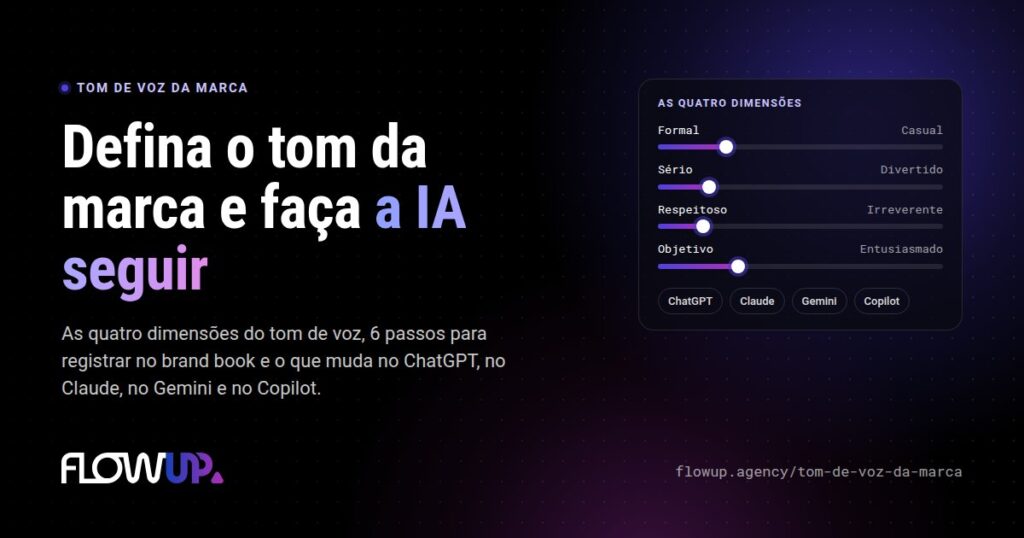
A practical way to define the tone is to use the four dimensions proposed by the Nielsen Norman Group. Each one is a scale, and the brand chooses a point on each:
Formal vs. casual: how close the writing comes to a conversation.
Serious vs. funny: whether there is room for humor, and in which situations.
Respectful vs. irreverent: how the brand treats the subject, the market and the reader.
Matter-of-fact vs. enthusiastic: how much excitement the brand shows about what it says.
Flowup, for example, sits close to formal without being stiff, and close to serious, respectful and matter-of-fact. That is why it avoids exclamation points, promises and words like "revolutionary."
How to define the brand tone of voice in 6 steps
1. Start from the positioning
The tone has to match what the brand promises and who it serves. A consulting firm for CFOs and a beverage brand for young people can be equally good and sound like opposites.
2. Read what the company already writes
Gather the website, proposals, posts, emails and replies to clients. Mark the texts that sound like the brand and the ones that do not. The differences show where a rule is missing.
3. Choose a point on each dimension
Use the four scales and write one sentence for each choice, with the reason. "Formal, because we talk to decision makers" gives more guidance than "professional."
4. Turn it into writing rules
Define what changes in practice: sentence length, active voice, use of acronyms, punctuation, words the brand uses and words it avoids.
5. Show right and wrong examples
Abstract rules get lost. A pair of examples for each common situation (post, email, proposal, reply to a complaint) teaches faster than a paragraph of explanation.
6. Record it in the brand book and review it
The tone of voice only counts when it lives in a place everyone consults. Review it every six months, and sooner whenever the company changes its positioning, audience or offer.
Three brand books published by Flowup show this step in practice, each with the voice of its sector: the one for HPROJ, a consulting engineering firm, also includes the standard for technical documents; those for Dr. Alexander Kopelman and Dr. Ana Vega combine the tone with Brazil's rules for medical advertising.
Example
A well-written rule works for a person and for an AI: "Use at most one call to action per piece, copied from the approved list." A vague rule, such as "be persuasive," works for neither.
Tone of voice in practice: right and wrong examples
The examples below follow Flowup's own guide.
Situation
Off tone
On tone
Introducing the company
"We are the best marketing agency in Brazil, the leader in results."
"Flowup is a Brazilian digital marketing agency specializing in Digital Authority Engineering."
Calling to action
"Get your company into ChatGPT in 30 days. Guaranteed!"
"We structure your brand to be understood and cited by AIs, and we measure what changes every month."
Using a figure
"Increase your traffic by 300%."
"In a study published in March 2026, 38% of the URLs cited in AI Overviews were also in the top 10 (Ahrefs)."
Answering a question
"Relax, we'll take care of everything!"
"It depends on your starting point. We explain what changes in each case and send the proposal in writing."
How to get AI tools to follow the tone of voice
Asking an AI to "write in my brand's tone" is not enough: the AI does not know the brand and fills the gaps with the generic marketing patterns it has learned. The way forward is to give it the same guide the team uses, in a format it can follow.
A short main instruction that says who the company is, how it speaks and which rules are never broken.
A brand file with official facts, vocabulary, approved calls to action and right and wrong examples.
A dedicated project in each tool: Projects in ChatGPT and in Claude, a Gem in Gemini and an agent in Copilot.
Prompts for each type of piece and a human review checklist before publishing.
On September 28, 2026, Flowup made the same request to Claude, ChatGPT and Gemini, with and without the brand file. Without the file, the pieces came out generic, with colors outside the palette and, in one case, with promises of results. With the file, they followed the voice and the rules. The calls to action were the weakest point, which is why the guide now asks for them to be copied word for word. It was a small test, with one round per model.
Important
In the same test, the Gem in Gemini refused the requests when the brand file was in its knowledge base, and answered within the voice when it received only the main instruction. Test the setup in each tool before rolling it out to the team.
Tone of voice checklist before publishing
Does the text sound like the brand on the four chosen dimensions?
Is there any word from the avoid list or any promise of results?
Does every number have a source and a date?
Is the call to action one of the approved ones, written the same way?
Is the company name spelled correctly?
Did someone on the team review it before publishing, especially if AI helped write it?
In short
Brand tone of voice is the consistent way a company speaks, adjusted to each situation and channel.
The Nielsen Norman Group's four dimensions (formal vs. casual, serious vs. funny, respectful vs. irreverent, matter-of-fact vs. enthusiastic) help choose the tone.
Writing rules and right and wrong examples turn the tone into something that can be applied.
For AI tools to follow it, the tone needs to be in a brand file and in a dedicated project in each tool, always with human review.
Frequently asked questions
What is the difference between voice and tone of voice?
Voice is the brand's personality, and it changes little. Tone is how that voice adjusts to each situation and channel, such as more care in a reply to a complaint and a lighter touch in a post.
Are tone of voice and verbal identity the same thing?
No. Verbal identity brings together name, tagline, messages, vocabulary and tone. Tone of voice is the part that defines how all of that sounds.
Where should the brand tone of voice be recorded?
The brand tone of voice should be recorded in the brand book, alongside the visual identity, with writing rules, words the brand uses and avoids, and right and wrong examples. A digital guide is easier for the team and for AI tools to consult.
Can AI maintain the brand tone of voice?
AI follows the brand tone of voice better when it receives the main instruction and the brand file in a dedicated project. Even so, every piece needs human review before it is published.
How often should the tone of voice be reviewed?
Reviewing the tone of voice every six months is a good pace, and sooner whenever the company changes its positioning, audience or offer.
The tone of voice is one part of the brand book. At Flowup, it comes together with the visual identity, the official facts and the package for the team's AI tools.
Brand Book for humans and AIs
Write your brand's tone once, for people and AIs
Flowup creates the brand, leads the rebrand or documents the identity you already have in a digital brand book.
Guto Bertoncini is the founder and lead strategist of Flowup Agency, which he has run since 2011. He is the author of the B.I.N.A. Method, Novo SEO and the Base Informacional Semântica (Semantic Information Base), and leads the agency's SEO for AI, GEO and AEO practice, preparing companies to be found on Google and cited by artificial intelligence platforms. He writes about search and AI on the Flowup blog and on his official website.
How Meta charges for the official WhatsApp API per message, Meta’s rates for Brazil in reais, the charge on service messages from October 1, 2026 and the AI rules in…
In engineering and technical B2B, marketing has to prove competence before the first sales contact. An approach built on trust, digital authority, SEO, GEO and AEO.
Related content
Need a quote?
Online now
Hi, this is Iasmin. Would you like a quote for your company?
Send
This site uses cookies to improve your experience. If you continue to use this site, you agree to their use. Privacy Policy