
Branding and visual identity for companies: a brand that people recognize and AIs describe the right way
Flowup is a branding agency that turns positioning into a complete brand system: brand platform, visual identity, verbal identity, brand book and the digital entity layer that helps Google and AI systems understand who your company is.
 By Guto Bertoncini, founder and lead strategist of FlowupUpdated on 17 min read
5.0 on GoogleSince 2011Proprietary B.I.N.A. Method








Summary
Branding and visual identity in seven points
The essentials of this page for anyone who needs to decide quickly. The details, the sources and the frequently asked questions are right below.
- Branding is the strategic management of how a brand is perceived: positioning, personality, messages and the experience it delivers over time.
- Visual identity is the system that gives that strategy a form: logo, color palette, typography, graphic elements, iconography and rules of application.
- A logo alone is not a brand. What builds recognition is the same system applied the same way at every touchpoint.
- A visual identity project for companies delivers a brand platform, a visual system, a verbal identity, templates and a brand book.
- Consistency has become a technical signal: Google and the AIs describe your company based on what the web says about it, and on how coherent that information is.
- That is why Flowup includes the digital entity kit: a canonical description, Organization and Brand structured data, and consistency guidelines for profiles and directories.
- The investment is defined per project, based on what the project includes, the volume of applications and the timeline, with a written proposal and no generic price list.
Definition
What is branding and what is visual identity?
Branding is the strategic process of building and managing a brand: positioning, purpose, personality, tone of voice and the perception the company builds over time. Visual identity is the tangible expression of that process: logo, colors, typography, graphic elements and applications organized into a consistent system.
Together, the two turn strategy into recognition. They define how the brand presents itself, how people perceive it and how search engines and AI systems understand and describe it.
Marty Neumeier, one of the leading voices in the discipline, defines a brand as a person's gut feeling about a product, a service or an organization. No one controls that feeling directly, but it can be influenced with consistency, repetition and judgment. That is what an identity system is for.
That is why, at Flowup, a branding project never starts with drawing. It starts with strategy: what the brand needs to communicate, to whom, in which territories and against which alternatives. Design comes in afterwards, and comes in stronger, because it has something to express.
The logo is the brand's signature. The visual identity is its language. Branding is the reason someone chooses and recommends your company.
Terms in this sectionEntityStructured dataOfficial AI Knowledge Base
Comparison
Logo, visual identity and branding: what is the difference?
The three terms are used as synonyms in everyday conversation, and the confusion is costly when it is time to hire. The table sets out the role of each one.
| Aspect | Logo | Visual identity | Branding |
|---|---|---|---|
| What it is | The graphic symbol that signs the brand | The complete visual system: logo, colors, typography, graphic elements and applications | The strategic process of building and managing how the brand is perceived |
| What it delivers | Isolated recognition | Consistency at every touchpoint | Positioning, differentiation and perceived value over time |
| The question it answers | Who signs this? | Is this from the same company? | Why choose and recommend this company? |
| How machines read it | An image file | Consistent visual signals across channels | An entity: a coherent definition, mentions and structured data |
| When to hire it | Almost never on its own | A new brand or an outdated system | Repositioning, growth, a merger or loss of differentiation |
Hiring only a logo, with no system and no strategy, usually leads to rework: the symbol exists, but the brand remains inconsistent in every proposal, screen and profile.
What you receive
What a visual identity project for companies delivers
The scope is modular, and not every project needs everything: the diagnosis defines what your brand requires. These are the six layers of a complete brand system.
Brand platform
Purpose, positioning, value proposition, personality and key messages. It is the foundation that guides visual and verbal decisions, and the source of the company's canonical definition.
Visual identity system
Logo and its versions, a palette with contrast criteria, typography, graphic elements, iconography and guidelines for photography and illustration, tested from mobile to print.
Verbal identity
Tone of voice, vocabulary, messages by audience and the brand bio: the standardized description that unifies what the brand says in each channel.
Brand book (brand manual)
A navigable, objective manual with clear usage rules, made so that teams and vendors can apply the brand without improvising.
Live examples: the brand books of HPROJ, Dr. Alexander Kopelman and Dr. Ana Vega.
Applications and templates
Digital stationery, email signatures, social media kits and the document and presentation templates defined in the scope.
Digital entity kit
Organization and Brand structured data in JSON-LD, with sameAs linking the website to the official profiles, standardized descriptions and consistency guidelines for search and AI.
Files that stay with the company
- Logo in all versions (primary, secondary, symbol and monochrome) in AI, EPS, SVG and PNG.
- Palette with Pantone, CMYK, RGB and HEX codes, with contrast and accessibility criteria.
- Typography with a defined hierarchy and licensing guidance.
- A navigable brand book and files organized for internal use and for vendors.
Criteria that apply to every project
- Strategy before design: no aesthetic decision without a brand platform.
- Legibility, contrast and reproduction tested before delivery.
- Fonts, images and assets with the license defined in the scope and communicated before delivery.
- Client material is kept out of public artificial intelligence tools.
Service options
Visual identity creation, rebranding, refresh or naming: what your moment calls for
The options can be hired separately or combined. The initial diagnosis indicates the level of intervention the brand really needs.
Complete brand identity
Creation from scratch: brand platform, visual system, verbal identity, applications and brand book. For new companies or brands that need to start again from the foundation.
Rebranding
Repositioning and redesign of an existing brand, with a transition strategy to preserve recognition, search history, profiles and mentions.
Brand refresh
Evolution, not rupture: modernizing the logo, palette, typography and system while keeping the recognition equity already built.
Naming
Creating a name for a company, product or service, with a preliminary check of domains, profiles and prior trademarks. Trademark registration (in Brazil, with INPI, the national trademark office) is left to intellectual property specialists.
Verbal identity
Tone of voice, vocabulary, messages and brand bio, for brands whose visual side is settled but whose written communication changes with every channel.
Brand systematization
The brand exists, but it has no system: we organize the rules and produce the missing manual and templates, without redesigning what already works.
The digital entity kit can also be hired on its own, by brands with an established identity that need consistency in search engines and in AI answers.
Portfolio
Visual identities created by Flowup
Visual identity projects published in the portfolio. Open each one to see the system applied.
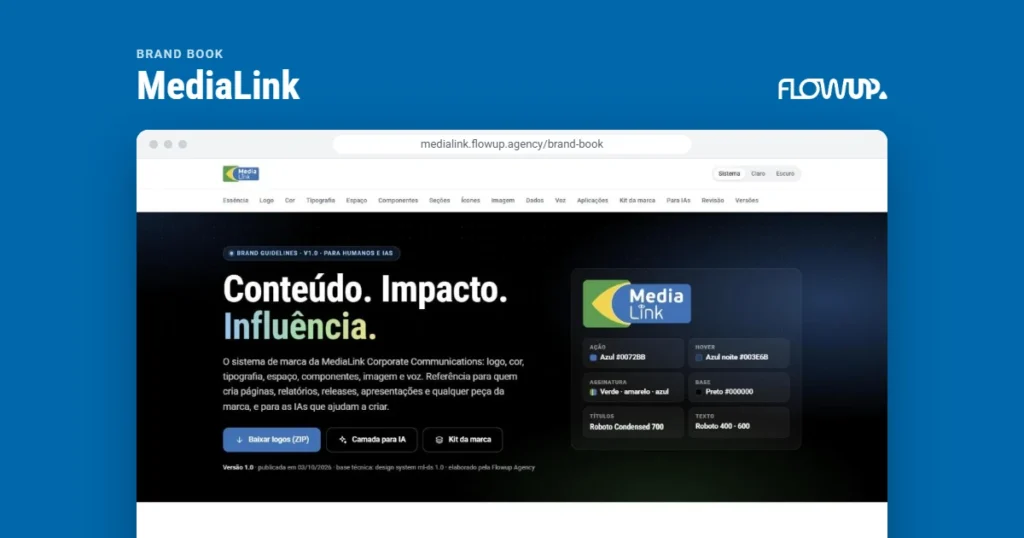 Brand booksBrand Book MediaLink
Guia de marca para humanos e IAs, com 16 seções e o logotipo redesenhado em vetor.
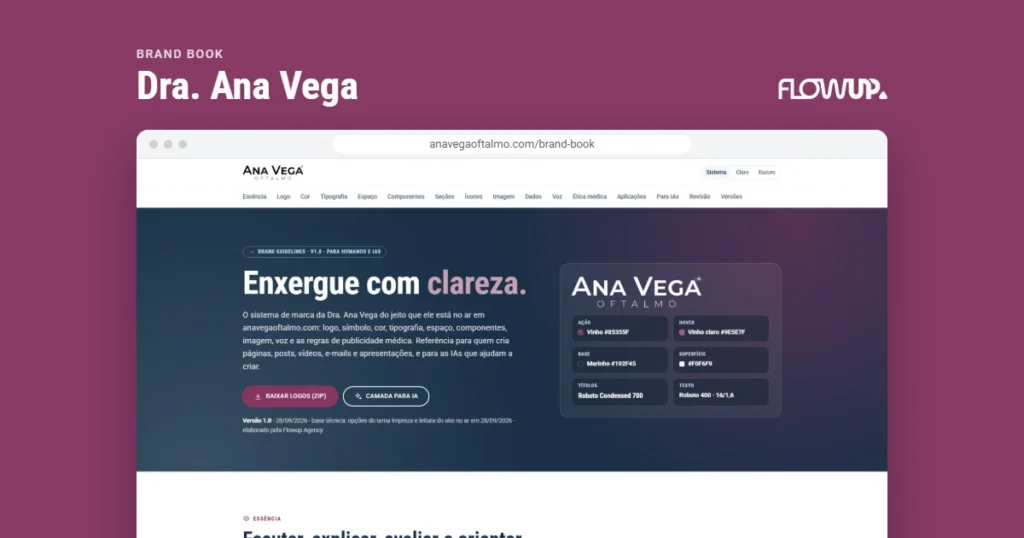 Brand booksDr. Ana Vega brand book
The ophthalmologist's brand guide for humans and AIs, with medical advertising rules.
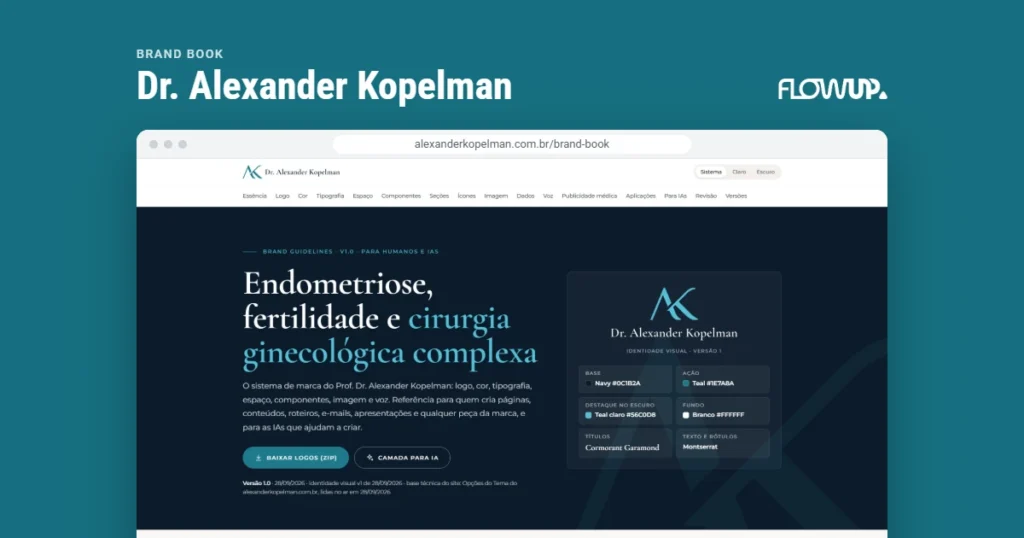 Brand booksDr. Alexander Kopelman brand book
Version 1 of the visual identity and a brand guide for humans and AIs, with a medical advertising section.
Method
How we create a visual identity: four phases, with validation at each one
Flowup's visual identity creation process follows four documented phases. Each phase ends with a validation by the company, so that the creative work is a consequence of the strategy, not of trial and error.
Immersion and diagnosis
Interviews with leadership, analysis of the market, audiences and competitors, an audit of the current identity and a reading of how search engines and AIs describe the brand today.
Brand platform
Positioning, purpose, personality, architecture and key messages. This is where the company's canonical definition comes from, which the website, the profiles and the structured data will repeat.
Creative direction and creation
Visual and verbal territories validated before execution. Then the system: logo, colors, typography, graphic elements and applications, tested in real contexts of use.
Documentation and activation
Refinement with legibility, contrast and reproduction tests, the brand book, technical files, templates and the digital entity layer implemented.
Brand and AI
Branding in the age of answers: your brand is also read by machines
A growing share of decisions starts without a single click. Google summarizes, ChatGPT describes, Perplexity compares. And what these platforms say about your company comes from what the web says about it.
- 68%of Google searches in the United States ended without a click in the first four months of 2026.SparkToro and Similarweb, 2026
- 1,200%increase in traffic from generative AI to U.S. retail websites, from July 2024 to February 2025.Adobe Analytics, 2025
- 4.4×is how much the visitor who arrives from an AI search is worth, on average, compared with the visitor from traditional organic search.Semrush, 2025
- Up to 33%revenue increase is what companies attribute to brand consistency; 81% deal with off-brand content.Lucidpress, 2019
An Ahrefs study of 75,000 brands showed that brand mentions on the web correlate more strongly with visibility in AI answers than backlinks do. In practice: a name, a definition and messages applied without variation are what allow machines to understand and cite your brand correctly. The same goes for the image: a current logo, published on the website with the company name in text, helps anyone who photographs the brand reach the right company, as we explain in the guide to image SEO.
This is where branding stops being a purely aesthetic discipline and becomes visibility infrastructure, the same logic behind Flowup's AI SEO, GEO and AEO fronts.
In answer engines, your brand is what the web says about it, consistently. Branding means taking control of that consistency.
How a brand becomes an entity that search engines and AIs understand
Canonical definition
A precise, standardized description: who the company is, what it does and for whom, defined in the brand platform and used the same way in every channel.
Corroboration
Profiles, directories, press and content that repeat the same definition. Each consistent mention reinforces the entity; each variation weakens the signal.
Structured data
Organization and Brand markup in JSON-LD, with sameAs connecting the website to the official profiles in a machine-verifiable identity.
Governed consistency
Visual and verbal identity applied without improvising, with a manual, templates and clear rules, because consistency has become a technical signal.
Investment and timeline
How much does a visual identity cost and how long does it take?
The investment in visual identity is defined per project, not from a price list. A standalone logo and a brand system are different products, with different costs.
Starting a company? Flowup Start brings together visual identity, Brand Book for humans and AIs, website and search foundation in a single project, with a defined scope. The price depends on the scope and, for international projects, is defined in a proposal. Learn about Flowup Start.
The price takes four variables into account, assessed in the first conversation:
- What the project includes: brand platform, visual system, verbal identity, naming or digital entity.
- The volume of applications and templates to produce.
- The starting point: new brand, rebranding, refresh or systematization.
- The timeline and the number of revision rounds.
After the conversation, you receive a written proposal, with scope, investment, schedule and deliverables defined.
The timeline depends on the scope: systematizing an existing brand is faster than creating a complete identity with naming. The schedule has stages and validation points, with a safety margin and no unrealistic promises.
Be wary of generic logo price lists. What you pay for in a brand project is the system that sustains recognition and value for years.
Who it is for
Who this service is for, and when it is not the best choice
What the projects have in common is not the industry: it is the understanding that the brand influences price, trust and choice.
Who gets the most value from the service
- B2B and technology companies that need to look the size they already are.
- Startups that are growing or raising capital.
- Consultancies and service companies that sell trust.
- Brands going through repositioning, a merger or a portfolio expansion.
- Companies with an identity, but without a system, manual or governance.
- Organizations that depend on organic acquisition and on a consistent presence in search and AI.
When it is not the best choice
- You only need a quick, cheap logo.
- You want a creative contest with dozens of options.
- The goal is to reproduce another company's identity.
- The timeline does not allow for the minimum of strategy.
In these cases, logo generators and template libraries are a better fit, and we would rather say so clearly than deliver a system that does not hold up.
Next step
How do the AIs describe your brand today?
The B.I.N.A. Diagnosis shows how your company appears and is described in search engines, answer engines and AI systems, and what the brand needs in order to be understood the right way.
FreePrioritized planNo commitment
Take the free B.I.N.A. DiagnosisI would like to thank you for the excellent work done on my company's marketing. The team was very attentive, professional and always available to adjust everything to our needs. The result was great and exceeded my expectations.
We have been Flowup's partners for more than 10 years and, over that time, our trust has only grown stronger. The service is excellent and the commitment to our requests is total. The team understands our needs, meets deadlines and delivers consistent quality.
Read the case study
Punctuality, quality and attention to each client's needs. That is our experience of working with Flowup, always very quick to find the most suitable and up-to-date solutions. They are preferred partners of MediaLink.
Frequently asked questions
Frequently asked questions about branding and visual identity
The questions that come up most often in searches and in conversations about brands.
Want to know what your brand needs: evolution, rebuilding or just governance? Share the context and receive an objective assessment.
Talk about my brandWhat is branding?
Branding is the strategic process of building and managing a brand. It involves positioning, purpose, personality, tone of voice, messages and the perception the company builds over time. It is what guides every decision about visual identity, communication and experience.
What is visual identity?
Visual identity is the system that gives the brand a visible form: the logo and its versions, color palette, typography, graphic elements, iconography and the rules of application. The goal is for any piece, from the website to a proposal, to be recognized as coming from the same company.
What is the difference between branding, visual identity and a logo?
A logo is the symbol that signs the brand. Visual identity is the complete system (logo, colors, typography, graphic elements and applications) that ensures consistency. Branding is the strategic process that defines positioning, personality and messages, and guides everything else. Hiring only a logo, with no system and no strategy, usually leads to rework.
How does the process of creating a visual identity work?
At Flowup, creation follows four phases: immersion and diagnosis, brand platform, creative direction and creation of the system, and documentation and activation. Each phase ends with a validation by the company, so that the design is a consequence of the strategy.
How much does a visual identity cost?
The investment is defined per project, according to what the project includes (brand platform, visual system, verbal identity, naming, digital entity), the volume of applications and the timeline. After the first conversation, you receive a written proposal, with scope and investment defined. A standalone logo and a brand system are different products.
How long does a branding project take?
It depends on the scope. Systematizing an existing brand is faster than a complete identity with naming. The schedule is defined in the proposal, with stages and validation points, and with a safety margin instead of unrealistic deadlines.
What is a brand platform?
It is the strategic document that defines the foundation of the brand: purpose, positioning, value proposition, personality and key messages. It ensures that the logo, copy, website and presentations say the same thing, and it is the source of the canonical definition used in the digital entity layer.
What is a brand book, or brand manual?
It is the document that governs the use of the brand: logo versions and clear space, palette and contrast criteria, typography and hierarchy, graphic elements, examples of application, mistakes to avoid and guidelines for tone of voice. At Flowup, the manual is objective and navigable, made to be used, and it also comes ready for the team's AI tools: it is the Brand Book for humans and AIs.
What is the difference between rebranding and a brand refresh?
A refresh is evolution, not rupture: modernizing the logo, palette, typography and system while keeping the positioning. Rebranding is transformation: strategic repositioning with a significant change of identity, sometimes even of name. The initial diagnosis indicates which path the company's moment calls for.
My company already has a well-known logo. Can the brand evolve without losing recognition?
Yes. The diagnosis identifies what makes up the brand's recognition equity, such as symbol, color and name, and the project preserves and modernizes those elements instead of discarding them. In a rebranding, the transition strategy also protects search history, profiles and mentions.
Do you handle naming and trademark registration with INPI, Brazil's trademark office?
We do naming with a method: name territories, evaluation criteria and a preliminary check of domains, profiles and prior trademarks. Registration with INPI is a legal procedure and should be conducted by intellectual property specialists. We guide the process, but we do not carry it out.
Which files do I receive at the end?
Logo in AI, EPS, SVG and PNG, in the primary, secondary, symbol and monochrome versions; palette with Pantone, CMYK, RGB and HEX codes; typography with licensing guidance; editable applications; a navigable brand book; and the files of the digital entity kit, when it is part of the project.
What is verbal identity and why does it matter?
It is the written dimension of the brand: tone of voice, vocabulary, messages by audience and the brand bio, the standardized description of the company. It matters because most touchpoints are text, and because it is the text, not the logo, that search engines and AIs read to understand who your company is.
How does branding influence what ChatGPT and Google say about my company?
Search engines and AI models describe the brand based on what is published about it, on your website and beyond it. When the name, the definition and the messages are consistent across all channels, machines consolidate a clear entity and tend to describe it correctly. When each channel says something different, the signal is diluted.
What is the brand's digital entity kit?
It is the technical consistency layer delivered along with the brand system: the organization's structured data in JSON-LD (Organization and Brand, with sameAs linking the official profiles), a standardized brand bio, ready-made descriptions for profiles and directories, and mention guidelines.
Do you apply the identity to the website, presentations and social media?
Yes. The same brand system can be applied to the WordPress website, as a design system and with performance, to PowerPoint presentation templates and to social media kits, without depending on other vendors to interpret the manual.
Do you use artificial intelligence in the creative process?
With judgment. AI can speed up operational steps, such as research and organizing materials, always under human creative direction and within the confidentiality policy: client material is not entered into public tools. Concept, strategy and creative decisions are human work.
Transparency
Sources and references
This page uses primary sources and published studies on brand, structured data and visibility in search engines and answer engines. Each statistic carries its source and year in the text itself.
- Organization structured data, Google Search Central: Google's documentation on Organization markup, logo, sameAs and company data.
- How to establish your brand entity for SEO: A 5-step guide, Search Engine Land: a guide on how to build and consolidate the brand entity for search engines.
- Top Brand Visibility Factors in ChatGPT, AI Mode, and AI Overviews (75k Brands Studied), Ahrefs: a study of 75,000 brands on the factors that correlate with visibility in AI answers.
- In 2026, Less than One Third of Google Searches Still Send a Click, SparkToro: a study with Similarweb data on zero-click searches in the United States in 2026.
- Adobe Analytics: Traffic to U.S. Retail Websites from Generative AI Sources Jumps 1,200 Percent, Adobe: Adobe Analytics data on traffic coming from generative AI.
- We Studied the Impact of AI Search on SEO Traffic. Here's What We Learned, Semrush: a study on the value of the visitor coming from AI search compared with organic search.
- State of Brand Consistency Report, Lucidpress (Marq): a survey on brand consistency, off-brand content and revenue.
- GEO: Generative Engine Optimization, arXiv: the academic paper that formalizes optimization for generative engines.
How to cite this page
Flowup Agency. Branding and visual identity for companies: a brand that people recognize and AIs describe the right way. Guto Bertoncini, updated on . flowup.agency/en/branding-and-visual-identity/
Is your brand ready to be seen and cited?
Send us your brand's context, or ask for a reading of how people, search engines and AIs see your company today. You receive an objective assessment of what the brand system needs: evolution, rebuilding or just governance.
5.0 on Google · Since 2011 · Case studies with stated sources

