
Semantic Information Base: the new foundation of digital authority in the age of AI
Companies do not just need to produce more content. They need to organize knowledge, intent, context and evidence in a structure that people, search engines, answer engines and artificial intelligence can understand.
 By Guto Bertoncini, founder and lead strategist of FlowupUpdated on 12 min read
For years, many companies treated SEO as a sum of keywords, blog posts and one-off technical optimizations. That approach can still generate traffic in specific scenarios, but it is no longer enough for an environment in which search interprets context, compares sources, identifies entities, answers questions and synthesizes information from multiple documents.
The Semantic Information Base comes from the need to organize a company's knowledge as a system. Instead of publishing disconnected pages, it structures what the brand is, what it offers, whom it serves, which problems it solves, how it thinks, which terms it masters, which questions it answers, what evidence it presents and how each piece of content relates to the next.
Proprietary definition: a Semantic Information Base is the structured set of information, pages, internal relationships, entities, answers, evidence and data that allows a company to be understood as a trusted source within a territory of authority.
This changes the logic of organic presence. The company stops asking only “which keyword are we going to rank for?” and starts asking “what do people, search engines and AIs need to understand about us to consider us a trusted reference on this subject?”
A Semantic Information Base is not an editorial calendar, a list of posts or a repository of texts. It is the strategic layer that organizes the company's digital presence so that every page has a function, an intent, a semantic relationship and a role within organic authority.
In practice, it works as an editorial and commercial source of truth. From it, the website, the blog, the service pages, the direct answers, the downloadable resources, the structured data and even the sales flows start to communicate the same narrative with more precision.
A Semantic Information Base is not:
- a blog with many unconnected articles;
- a collection of pages created only for keywords;
- a hidden internal manual that generates no organic presence;
- a technical SEO checklist applied without strategy;
- a package of texts created for volume, without depth and without governance.
A shift in search
Why this matters in New SEO, GEO and AEO
Search is no longer just a page of links: it is becoming an environment of answers, recommendations, comparisons and syntheses generated by systems that depend more and more on context.
SEO: clarity to crawl, understand and index
SEO remains the technical and editorial foundation of organic presence. An information base improves URL structure, titles, internal links, content hierarchy, scannability and relevance signals.
GEO: context for generative engines
GEO extends the strategy to generative experiences. The goal is not to manipulate AI, but to make the brand more understandable, verifiable and useful when systems synthesize information from different sources.
AEO: direct answers to real questions
AEO requires content that answers questions in an objective, complete and citable way. An information base organizes questions, answers, concepts, decision criteria and FAQs by search intent.
The central point: GEO and AEO do not replace traditional SEO. They extend its role. New SEO connects technical fundamentals, information architecture, editorial clarity, semantic authority and digital assets prepared for AI search environments.
Components
What goes into a Semantic Information Base
A robust base combines business strategy, information architecture, search intent, editorial narrative and technical implementation. It has to be useful to humans and readable by systems.
The company's strategic truth
A clear definition of positioning, value proposition, services, differentiators, audiences, segments, problems solved, qualification criteria and proof of authority.
Intent map
The organization of the informational, comparative, commercial, transactional and brand searches that show how the audience searches, understands and decides.
Entities and semantic relationships
A map of the core concepts, related terms, adjacent topics, synonyms, questions, attributes and relationships that help systems understand the brand's territory.
Page architecture
The definition of pillar pages, clusters, commercial pages, a glossary, articles, studies, case studies and tools, each with a clear function within organic authority.
Answer blocks and FAQs
Direct answers, short explanations, comparisons, lists, objections, frequently asked questions and citable passages that support AEO and answer engines.
Structured data and governance
Consistent use of Schema.org, metadata, breadcrumbs, connected pages, authorship, updates, sources and editorial rules to keep everything consistent over time.
A page published with no relationship to the rest of the site may attract occasional visits, but it will hardly sustain authority on its own. Digital authority emerges when several pieces reinforce the same semantic territory, answer complementary intents and help the user move from an initial question to a better-informed decision.
That is why the Semantic Information Base is the foundation of the Digital Asset. It lets the organic channel work continuously for the company: educating the market, qualifying leads, reducing recurring questions, strengthening the perception of expertise and creating a digital memory that can be reused in SEO, sales, customer service, campaigns, automations and AI agents.
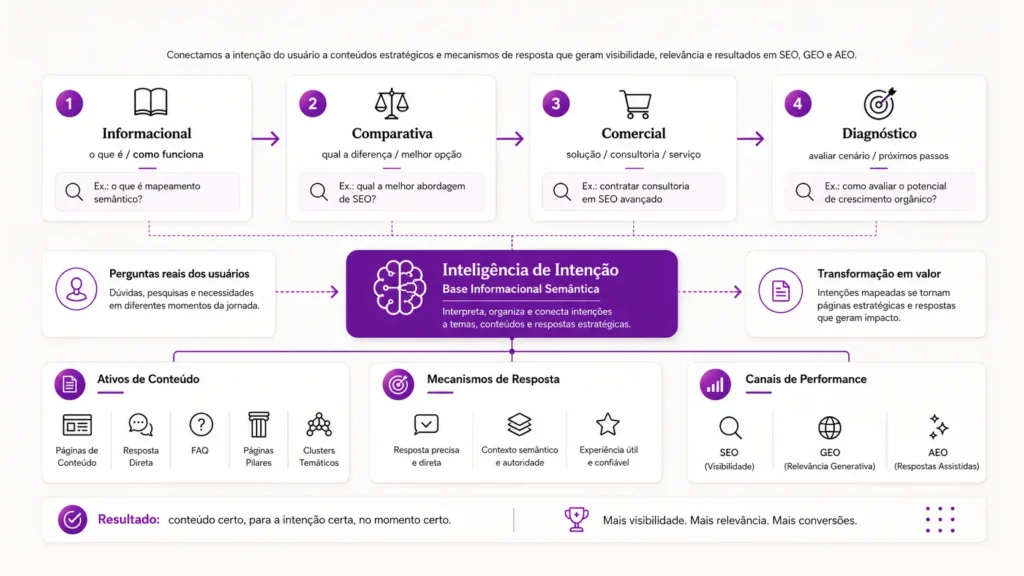
The long-term value is not in publishing more. It is in turning the company's knowledge into a clear, cumulative structure that can be consulted. It is the point at which content stops being a recurring cost and becomes a lasting digital asset.
Practical application
How the base changes the work of marketing, SEO and sales
When a company has no information base, every channel explains the brand in its own way. The website says one thing, the sales team says another, the blog covers disconnected topics, paid media leads to generic pages and the audience's questions keep coming back without a consistent answer.
With a structured base, the operation gains clarity. The team knows which questions to answer, which pages to prioritize, which terms to master, which comparisons to produce, what evidence to present and how to turn recurring questions into organic assets.
Marketing
Reduces scattered briefs and guides editorial production with clear intent.
SEO
Organizes architecture, internal links, entities and topical depth.
Sales
Turns questions and objections into pages, answers and consultative arguments.
Brand
Creates narrative consistency across the website, content, ads, customer service and presentations.
AI
Provides clearer context for tools, assistants, answer engines and generative experiences.
How Flowup applies it
Flowup builds Semantic Information Bases to turn companies into clearer, more trustworthy and more citable sources
Flowup does not treat the Semantic Information Base as a one-off content deliverable. It is built as part of an Organic Dominance Architecture: a system that connects diagnosis, search intent, pillar pages, clusters, commercial content, a glossary, studies, structured data and strategic CTAs.
The work starts with understanding the business and the territory of authority the company wants to occupy. Flowup then organizes the knowledge into publishable, scannable and connected structures, with a focus on clarity for people, search engines, answer engines and artificial intelligence.
This view underpins services such as GEO and AEO consulting, AI SEO, digital authority building and the development of organic digital assets. The B.I.N.A. Method turns that work into a structured process.
Information Base
Organizes the company's strategic truth, its core topics, entities, services, evidence and the page architecture that sustains authority.
See layer B in the methodIntent Intelligence
Maps how the audience searches, compares, understands, questions and decides, turning search intent into editorial and commercial structure.
See layer I in the methodAuthority Core
Defines the proprietary topics and the essential pages that make the company recognized as a source in a strategic territory.
See layer N in the methodDigital Asset
Converts the base into pages, clusters, answers, structured data and flows that work continuously to generate clarity, authority and opportunities.
See layer A in the method
Authority and clarity diagnosis
An assessment of the website, existing content, gaps, unanswered intents, competing pages, key entities, commercial messages and opportunities for differentiation.
Semantic map and intent map
The organization of topics into pillars, clusters, comparisons, a glossary, commercial pages, downloadable resources and short answers to priority questions.
Organic Dominance Architecture
The definition of each page's function within the site, with hierarchy, internal links, CTAs, structured data, breadcrumbs and its place in the decision journey.
Editorial production and implementation
The creation of useful, in-depth, scannable and technically organized pages, with direct answer blocks, practical examples, FAQs and appropriate metadata.
Governance and continuous evolution
Content updates, cluster expansion, performance analysis, gap reviews, entity enrichment and the conversion of what the sales team learns into new assets.
Short term: clarity and consistency
The company starts to explain better what it does, for whom, why it matters and how it stands apart. This improves existing pages, briefs, CTAs, sales arguments and recurring answers.
Medium term: semantic authority
Connected pages, well-defined clusters and objective answers strengthen how the domain is understood around strategic topics, reducing dependence on scattered content.
Long term: organic digital asset
The base becomes a reusable asset: it educates the market, sustains SEO, supports GEO and AEO, qualifies leads, guides sales and creates digital memory for new technologies.
Companies that do not organize their information are more vulnerable in AI search environments. The problem is not just losing positions. The risk is being misunderstood, being summarized incompletely, depending on third parties to explain their expertise or appearing less often when users ask complex questions.
When a company's knowledge is fragmented, its authority signals are weak. The website does not make clear which topics it masters, the blog does not support an architecture, the commercial pages do not answer objections, the pieces of content do not reference one another, the structured data does not reinforce meaning and the brand does not build a cumulative organic presence.
Signs that your company needs a base
- content published with no clear relationship between the pieces;
- generic service pages that look like the competitors';
- recurring sales questions with no published answers;
- excessive dependence on paid media to generate demand;
- no pillar pages or intent-based clusters;
- no glossary, structured data or editorial governance;
- difficulty explaining what sets the company apart in a few minutes.
Complex B2B company
A company that sells consultative solutions can structure pages about problems, comparisons, selection criteria, segments served, methodology, case studies and FAQs, helping the decision maker understand the value before the sales conversation.
Clinic or specialized service
A clinic can organize specialties, symptoms, treatments, questions, differentiators, team, protocols, indications and trust criteria, reducing superficial content and strengthening technical authority.
Brand that wants to be cited by AIs
A brand can make its definitions, services, data, processes, questions and evidence clearer, making it easier for answer engines to understand the context and cite the company when it is relevant.
Next step
Is your company clear enough to be understood, recommended and cited?
The B.I.N.A. Diagnosis shows, in 12 questions, whether your company's website has an information base capable of sustaining digital authority on Google, in answer engines and in AI search experiences.
FreeInstant resultNo commitment
Take the free B.I.N.A. DiagnosisFrequently asked questions
Frequently asked questions about the Semantic Information Base
What people usually ask about the first layer of the B.I.N.A. Method.
Want to know whether your company already has a clear base?
Take the B.I.N.A. DiagnosisWhat is a Semantic Information Base?
It is an organized structure of digital knowledge that connects the company's strategic information, pages, entities, search intents, answers, structured data and proof of authority to make the brand clearer and easier to understand.
What is the difference between a Semantic Information Base and a blog?
A blog is an editorial format. The Semantic Information Base is the architecture that defines which content needs to exist, what function each piece serves, how the pieces connect and what authority they build together.
Does a Semantic Information Base replace SEO?
No. It strengthens SEO. The base organizes content, intent, structure, internal links, entities and answers, helping the technical and editorial fundamentals of SEO work with more context.
How does the base help with GEO and AEO?
It produces content that is clearer, more objective and easier to connect. This favors direct answers, semantic understanding, contextual citations and reading by engines that synthesize information from multiple sources.
Does this guarantee appearing in AI Overviews, ChatGPT or other AIs?
No. No serious strategy should promise guaranteed presence in search engines or AI. The goal is to improve clarity, authority, usefulness, crawlability and the ability to be cited when the company is relevant to the query.
What types of pages are part of the base?
Pillar pages, intent-based clusters, commercial pages, a glossary, strategic articles, studies, case studies, FAQs, downloadable resources, institutional pages and process content can all be part of the base, as long as each one has a clear function.
How does Flowup build a Semantic Information Base?
Flowup starts with a diagnosis, maps intents and entities, structures the organic architecture, produces strategic pages, implements data and CTAs, organizes internal links and evolves the base with continuous governance.
When should a company invest in this?
When it depends on authority, trust, demand generation, market education, technical differentiation or a sustainable organic presence. The more complex the service or product, the greater the value of a structured base tends to be.
Transparency
Sources and references
The Semantic Information Base strategy is proprietary to Flowup, but it builds on public fundamentals of SEO, structured data, generative experiences and answer engine optimization.
- AI features and your website, Google Search Central: SEO best practices remain relevant for AI features in Search, with a focus on content that is helpful, crawlable, indexable, semantically clear and technically accessible.
- Introduction to structured data markup in Google Search, Google Search Central: Schema.org and JSON-LD help make the meaning of pages, entities, breadcrumbs and FAQs explicit, as long as they describe visible content and are not treated as a promise of guaranteed results.
- GEO: Generative Engine Optimization (arXiv): the concept was formalized in studies that analyze how generative engines synthesize answers and cite sources.
- Schema.org: FAQPage: vocabularies such as WebPage, WebSite, BreadcrumbList, DefinedTerm and FAQPage help describe the page and its relationships in a standardized way.
How to cite this page
Flowup Agency. Semantic Information Base: the new foundation of digital authority in the age of AI. Available at: https://flowup.agency/en/semantic-information-base/.
Is your company clear to Google and to the AIs?
Find out whether your digital presence has a Semantic Information Base capable of generating authority, context and organic opportunities.
5.0 on Google · Since 2011 · Case studies with stated sources

