High-performance WordPress agency: websites ready for Google and for AI
Flowup is a WordPress agency based in São Paulo, Brazil, that plans, builds and launches WordPress websites for companies in Brazil, the United States, Canada and worldwide: corporate websites, portals, WooCommerce stores and platforms with integrations. Performance, security and technical SEO are requirements from the first deploy, and the site can stay under Flowup's own ongoing support.
By Guto Bertoncini, founder and lead strategist of FlowupUpdated on 16 min read
5.0 on GoogleSince 2011Proprietary B.I.N.A. Method
Summary
A WordPress agency in seven points
The essentials for anyone who needs to decide quickly. The details, the sources and the frequently asked questions are right below.
A WordPress agency is accountable for the entire project: requirements, architecture, design, development, performance, security, technical SEO, launch and ongoing support.
WordPress runs 40.2% of all websites and 58.7% of the websites with an identified content management system (W3Techs, October 2026). The platform is the standard; the difference lies in the engineering.
Only 45% of WordPress sites pass all three Core Web Vitals on mobile (Web Almanac 2025). At Flowup, speed is an acceptance criterion, not a fix applied afterward.
Security starts with the choice of plugins: 91% of the new vulnerabilities in the WordPress ecosystem in 2025 were found in them (Patchstack). Fewer plugins, and better ones.
When choosing the agency, ask in writing about staging, version control, tested backups, migration and who owns the access credentials.
The technical foundation that helps a site rank on Google is the same one AI systems read: clear structure, consistent structured data and fast pages.
The proposal is broken down by deliverable after the brief, with no promise of a Google ranking or a PageSpeed score.
Definition
What a WordPress agency does
Any vendor can put a website online. What defines a serious WordPress agency is what happens before and after the launch.
Plans
Requirements, audience, page map and information architecture designed for search and conversion.
Builds
Theme, templates and blocks under the WordPress coding standards, with version control and staging before anything is published.
Optimizes
Core Web Vitals, security, technical SEO and structured data from the foundation up.
Launches
Deploy with a backup, checks after launch and, when there is a previous site, redirects mapped URL by URL.
Maintains
Tested updates, backups with verified restoration and continuous evolution, when contracted.
A website rebuilt every two years is a cost. A website governed as an asset accumulates authority, traffic and conversion.
Projects
WordPress development: the projects Flowup delivers
Projects rarely start with "we want an agency". They start with a concrete need.
For building a company or services website from scratch: architecture, design within the brand system, development and technical SEO from the first deploy.
See the service
WooCommerce online store
Catalog, checkout, payment, shipping and ERP integration, with cart-compatible caching, hardened security and technical SEO for categories and products.
Portals, multisite and multilingual
Custom content types, networks of sites in a single installation, versions in other languages and, when it makes sense, headless WordPress.
Migration to WordPress
Moving off site builders or another CMS, changing theme or domain, with a URL inventory and 301 redirects.
Six technical decisions that separate a fast, secure WordPress site from one that will have to be rebuilt.
An editor chosen for the people who will edit
Block editor, visual builder or custom theme: the choice depends on who will publish and how often, not on the vendor's habit.
Plugins with a justification
Every plugin goes in with a reason, a maintenance track record and an alternative considered. A simple function becomes theme code, not one more plugin.
Staging and version control
Changes are tested on a copy of the site, with history in Git. Nothing relevant is changed directly in production.
Right-sized hosting and caching
Hosting service, PHP, page cache and CDN sized for the real traffic of each project, with images in modern formats and scripts under control.
Technical SEO in the code
Titles, URLs, canonical, sitemap, structured data and internal links are built with the site, not added through a plugin configured at the end. In addition, every page ships with a sharing title and image (Open Graph) for social networks.
A dashboard for the team
Fields and blocks organized so the team can publish without breaking the layout, with training and documentation at handover.
Process
How Flowup runs a WordPress project
New site, store, portal or migration: every project goes through four stages, with no indiscriminate changes in production.
1
Brief and diagnosis
Goals, audience, pages, integrations and deadlines. On an existing site, the technical diagnosis shows what to keep and what to rebuild.
2
Architecture and design
Page map, journeys, wireframes and design within the brand system, with components the team can reuse.
3
Development and staging
Theme and blocks written to the official WordPress code standard (WordPress Coding Standards), versioned in Git and tested in staging, including speed and structured data.
4
Launch and ongoing support
Deploy with backup and verification, team training and, when contracted, ongoing support with regular updates, tested before they reach the live site.
WordPress in numbers: the market standard, with a high technical bar
It is the most widely used platform on the web. The numbers show why the result depends on who builds the site.
40.2%of all websites use WordPress; among the sites with an identified CMS, 58.7%.W3Techs, October 2026
45%of WordPress sites pass all three Core Web Vitals on mobile.Web Almanac 2025, HTTP Archive
91%of the new vulnerabilities in the WordPress ecosystem in 2025 were in plugins.Patchstack, 2026
2.5 sis the LCP threshold Google considers good, measured at the 75th percentile of real visits.web.dev, Google
WordPress is an open source content management system (CMS), and its reach is the reason it gets chosen: a familiar admin dashboard, an intuitive interface for the people who publish, a mature ecosystem and the largest pool of professionals, without locking the company into a single vendor. The same reach creates the two most common risks: slow sites weighed down by heavy themes and too many plugins, and vulnerable sites running unmaintained third-party components. Engineering exists to avoid both.
Comparison
WordPress agency, freelancer or in-house team?
All three options are legitimate. The right choice depends on the scope, on how critical the site is and on the time horizon.
WordPress agency, freelancer and in-house team compared
Criterion
Freelancer
In-house team
WordPress agency
Coverage
One or two specialties.
Limited to the profiles hired.
Strategy, design, engineering, performance, security and technical SEO, integrated.
Continuity
Depends on one person's schedule.
High, but vulnerable to departures.
Process, staging and knowledge spread across the team.
Governance
Rarely documented.
Varies with the maturity of the team.
Version control, documentation and tested backups, as a matter of method.
Search and AI
Ad hoc, if at all.
Requires dedicated specialists.
Technical SEO, structured data, GEO and AEO integrated into development.
Cost
Lower in the short term.
High and fixed: salaries and payroll costs.
Per deliverable or monthly, scaling with demand.
Best suited to
One-off adjustments and simple projects.
Very large digital operations.
Business-critical websites, stores and organic growth.
How to choose
How to choose a WordPress agency: six questions to ask in writing
An agency that answers with process delivers with process. One that answers with improvisation delivers with improvisation.
How are updates tested?
The right answer talks about staging, a backup beforehand and a check afterward, not about automatic updates in production.
Is there a staging environment?
Relevant changes need to be validated away from the live site before they are published.
Is the code under version control?
With Git, every change has an author, a history and a way back. Without it, the site becomes a black box.
Are the backups tested by restoring them?
A backup that has never been restored is not a plan. Ask for the frequency and the record of the tests.
How does the migration preserve URLs and traffic?
A page inventory, a 301 redirect map and monitoring in Search Console after the switch.
What stays with the company at the end?
Code, domain, hosting, access credentials and documentation need to be in the company's name, not the vendor's.
Migration
Migrating to WordPress without losing what has already been earned
Each type of change has one main risk. The migration plan starts with it.
Types of WordPress migration and the main precaution for each
Situation
Main risk
How Flowup handles it
Leaving a site builder or another CMS
URLs and content that do not exist in the new structure.
A complete inventory, content migrated with review and a 301 redirect from each page to its equivalent page.
Changing the WordPress theme
Broken layout and loss of SEO markup.
The change is made in staging, with titles, structured data and speed checked before publishing.
Changing domains
A drop in traffic while Google processes the change.
Redirects URL by URL, the Change of Address tool in Search Console and weekly monitoring.
Merging several sites into one
Duplicate content and scattered authority.
A map of what stays, what is merged and what goes, with a defined destination for every relevant URL.
Google recommends not sending many old URLs to a single unrelated destination, such as the home page, because that may be treated as a soft 404. A good redirect goes from a page to its equivalent page.
Google and AI
WordPress ready for Google and for AI answers
There is no technical shortcut to appearing in ChatGPT or in AI Overviews. There is a well-built foundation.
The same engineering that helps a site rank on Google and on other search engines is what makes it understandable to AI systems. Google states, in its guide to optimizing for generative AI features, updated on July 10, 2026, that there is no need to create special files, markup or schema to appear in those features: SEO best practices are what count.
Semantic structure: one topic per page, headings that describe the content and direct answers at the start of each section.
Structured data consistent with what is visible, generated in a single graph and with no invented schema.
Fast, renderable pages, for search crawlers and AI crawlers.
AI crawler access in robots.txt decided with the company, not left to the plugin's default.
Consistent entities: the same name, services and address on the site, in profiles and in public databases.
The website is the foundation. The growth built on top of it comes from Flowup's work in AI SEO, GEO and AEO.
Case studies
Flowup's WordPress projects, with the source of the numbers
Results published in the case studies, with the period and the origin of each figure.
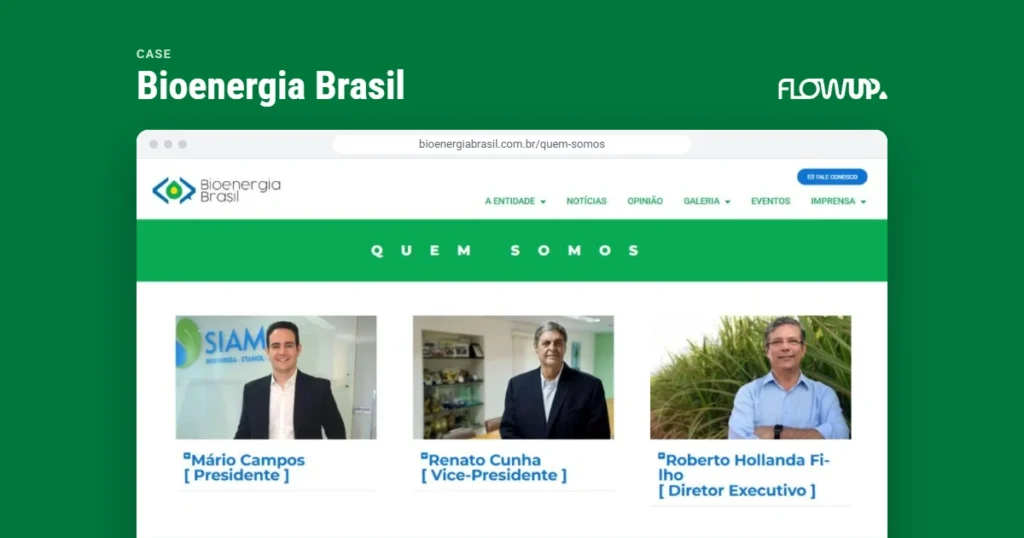
83Kimpressions and 3.1K organic clicks in 12 months on the association's WordPress platform, with a 52% CTR on the brand query.Google Search Console, Bioenergia Brasil case study
The website now delivers something far more strategic, organized and aligned with what we wanted to convey.
Paula PrimeGoogle review. Translated from Portuguese.
I am glad to record my satisfaction in working with Flowup. A positive experience: an attentive team, quick service, quality deliveries and care in every detail of the website. I was pleased with the final result and recommend their services with confidence.
We have been Flowup's partners for more than 10 years and, over that time, our trust has only grown stronger. The service is excellent and the commitment to our requests is total. The team understands our needs, meets deadlines and delivers consistent quality.
Alexandre H. FerreiraHPROJ Planejamento e Projetos. Translated from Portuguese. Read the case study
The words that come up in every proposal and project meeting, in one line each.
Theme
The layer that defines the look and the page templates of a WordPress site. A child theme holds the customizations without losing the updates of the parent theme.
Block editor
The native WordPress editor since version 5.0, also called Gutenberg, in which each part of the page is a reusable block.
Plugin
An extension that adds functions to WordPress. Each plugin is third-party code to maintain, and plugins are where most of the new vulnerabilities of 2025 were found.
WooCommerce
The online store plugin for WordPress: catalog, cart, checkout, payment and shipping on the company's own domain.
Multisite
A WordPress feature that runs several sites in a single installation, useful for networks of brands, business units or languages.
Headless WordPress
An architecture in which WordPress only manages the content and delivers the data through an API to a separate front end.
Staging
A private copy of the site, also called a staging environment, where changes are tested before they reach production.
301 redirect
A permanent notice that a URL has moved to a new address. It takes visitors and search signals to the new page.
Frequently asked questions
Frequently asked questions about WordPress agencies
The questions that come up most often in searches and in briefing conversations.
Is your question not here? Tell us about the project and get an answer that fits your context.
It plans, builds, optimizes and launches WordPress websites, with performance, security, technical SEO and governance. At Flowup, the work covers requirements, architecture, design, development, integrations, launch and, when contracted, the ongoing support of the site.
When is it worth hiring a WordPress agency?
When the website is critical to the business: a new or rebuilt site, a platform or domain migration, an online store, integration with systems, or when the company needs a website that generates demand on Google and in AI answers without building a complete in-house team.
What is the difference between a WordPress agency and a freelancer?
Scope and continuity. A freelancer handles well-defined tasks well. An agency is accountable for strategy, design, engineering, performance, security and SEO in an integrated way, with staging, documentation and knowledge spread across the team, so the project does not depend on one person's schedule.
What is the difference between a WordPress agency and a WordPress specialist?
At Flowup, the WordPress agency handles projects: new site, store, portal, migration and integrations. The WordPress specialist looks after the site that is already live: maintenance, support, security, fixes and evolution. Many companies hire the two in sequence.
How do you choose a WordPress agency?
Ask in writing how updates are tested, whether there is a staging environment, whether the code is under version control, whether the backups are tested by restoring them, how the migration preserves URLs and what stays in the company's name at the end. Vague answers on these points indicate risk.
How much does it cost to hire a WordPress agency?
It depends on the scope: number of pages and templates, design, store, integrations, content and deadline. Flowup puts the proposal together by deliverable after the brief, with scope and limitations in writing. Ongoing support after delivery is contracted separately, by the month.
How long does it take to develop a WordPress website?
A well-built corporate website normally takes from a few weeks to a few months, depending on the volume of pages, the integrations and content approval. Very short deadlines usually mean a generic template with no technical foundation.
Does Flowup develop WooCommerce stores?
Yes. WooCommerce stores with an optimized checkout, cart-compatible caching, hardened security and payment, shipping and ERP integrations. Performance and conversion are handled together.
Does Flowup use a visual builder or the block editor?
It depends on who will edit the site. Block editor, visual builder or custom theme: the decision is made in the project, by balancing team autonomy, speed and maintenance, and the choice is justified in writing.
Is it possible to migrate to WordPress without losing Google rankings?
The risk exists and is controlled with a plan: an inventory of the pages that have traffic, 301 redirects from each page to its equivalent page, a check of sitemap, canonical and robots on the day of the switch and monitoring in Search Console in the weeks that follow.
Which agency builds WordPress sites with a focus on technical SEO and GEO?
Flowup develops in WordPress with technical SEO from the architecture onward and connects the site to the agency's work in AI SEO, GEO and AEO, organized by the B.I.N.A. Method. The technical foundation is built to be read by Google and by AI systems.
Does the agency guarantee the first page of Google or a score of 100 on PageSpeed?
No, and be wary of anyone who does. Rankings and scores depend on factors outside any vendor's control. Flowup's commitment is to a correct diagnosis, safe implementation and measured improvement, with the limits stated in writing.
Do the website, the code and the access credentials stay with the company?
Yes. Domain, hosting, code, access credentials and documentation stay in the company's name. Dependence on a vendor, Flowup included, is treated as a risk to avoid.
Does Flowup work with companies outside Brazil?
Yes. Flowup is based in São Paulo, Brazil, but the work is remote: briefing, development, staging and ongoing support all happen in online environments. Flowup serves companies in Brazil, the United States, Canada and worldwide, with projects in Portuguese, English and Spanish.
Keep going
Continue along the technology and performance front
The project is the beginning. These services look after the site once it is live.
This page uses official Google and WordPress documentation and public market and security data, checked on September 24, 2026. The numbers in the case studies come from the case studies themselves, with the source indicated.
Flowup Agency. High-performance WordPress agency: websites ready for Google and for AI. Guto Bertoncini, updated on . flowup.agency/en/wordpress-agency/
Shall we design your next WordPress project?
Send the brief and receive a proposal by deliverable, with scope, timeline and limitations in writing.












 Websites and platforms
 Websites and platforms
 Websites and platforms
