
PowerPoint presentation agency: narrative and slide design for the moments when your company needs to persuade
Flowup turns technical, commercial and corporate content into professional PowerPoint presentations: narrative, slide design and data visualization for executive meetings, proposals, competitive bids and pitch decks. 100% editable files, with confidentiality covered in the contract.
 By Guto Bertoncini, founder and lead strategist of FlowupUpdated on 15 min read
5.0 on GoogleSince 2011Proprietary B.I.N.A. Method










Summary
Professional presentations in seven points
The essentials of this page for those who need to decide quickly. The details and the frequently asked questions are right below.
- A premium presentation is a decision-making document: it organizes the information, guides the audience and supports the perceived value of the company.
- The presentation designer organizes the hierarchy, sets the art direction, designs the charts and builds the PowerPoint file with a slide master and layouts.
- The sequence is always the same: strategy, then narrative, then slide design. That is what separates a presentation from a decorated file.
- We develop executive and board presentations, sales presentations, technical proposals, pitch decks, public tender presentations, corporate presentations and training materials.
- Technical, lengthy and complex content is a specialty: engineering, financial data, legal arguments and regulatory documents.
- Delivery is always an editable .pptx, with a PDF for digital distribution and, when contracted, a corporate template with a layout library.
- Pricing is per project, not per slide. All material is confidential by default, with an NDA available and no use of public AI tools.
Definition
What is a premium presentation and what does a presentation designer do?
A premium presentation is a strategic communication structure, created to organize information, guide the audience and strengthen the perceived value of a company, proposal or project. It is not a set of well-designed slides: it is a decision-making document.
The work begins before the first slide: understanding which decision the presentation needs to support, who the audience is and in what context the material will be used, whether projected in a meeting room, sent by email or defended in a competitive bid. Only then does the information gain a logical sequence, the visual hierarchy get defined and the design give shape to the reasoning.
The presentation designer is the professional who turns content into slides that communicate. They organize the information hierarchy, set the art direction, design charts, diagrams and infographics and build the PowerPoint file with a slide master and layouts, so that the presentation remains editable after delivery.
It is worth hiring a specialized designer when the presentation carries weight in the decision: a business proposal, a pitch deck for investors, a competitive bid, results for the board or technical material that needs to be understood by non-specialists. In these cases, the slide stops being a visual aid and becomes part of the argument.
Research on multimedia learning shows that irrelevant elements compete for the audience's working memory. Overloaded slides hurt comprehension, not for lack of aesthetics, but because of excess noise.
Design, here, is not decoration. It is the engineering of perception: clearing away what gets in the way and giving shape to what needs to be understood.
Comparison
Presentation agency, freelance designer or template: which one to choose?
The three options solve different problems. The table helps you decide by the weight of the presentation, not by price.
| Criterion | Ready-made template | Freelance designer | Presentation agency |
|---|---|---|---|
| When it makes sense | Internal, simple material that carries no weight in the decision | A one-off request, with a simple scope and content already structured | Strategic or technical material, a critical deadline or several presentations that must follow one standard |
| Narrative | Left to whoever fills it in | Usually outside the scope | Narrative architecture before design |
| Data visualization | Generic charts from the template | Depends on the professional | Editable charts chosen by the message |
| Editability | Depends on the template | Varies from project to project | Slide master and structured layouts, always |
| Confidentiality | Not applicable | Individual agreement | NDA available and a stated AI policy |
When the content is already well structured and only the visual layer is missing, Flowup also works in the slide design format, and says clearly what this level of intervention solves and what it does not.
Types of presentation
Corporate, executive and sales presentations and pitch decks: what we develop
Not every presentation plays the same role. A technical proposal demands documentary rigor; an investor pitch demands synthesis and a progression of argument; a board presentation demands objectivity and has to be readable on its own.
Executive and board
Results reports, strategic presentations, feasibility studies and project defenses, readable on their own by those who were not in the meeting.
Sales and proposals
Commercial and sales presentations, business and technical proposals, product and service presentations.
Pitch deck and investors
Pitch decks for fundraising and investor presentations, with synthesis, a progression of argument and data that support the thesis.
Public tenders and consortia
Presentations for public tenders, competitive bids and large projects, aligned with the tender documents and with the way evaluation panels and committees assess them.
Corporate and events
Corporate presentations, conventions, events and talks, with the company's identity applied from end to end.
Redesign and standardization
Reworking existing presentations, standardizing materials from several teams and modernizing legacy files.
Sectors we serve frequently: engineering and infrastructure, real estate developers, financial institutions and funds, consultancies, technology and startups, law firms and large companies, from sales and marketing to investor relations and executive leadership.
Formats
Creation, redesign or slide design only: the ways to hire us
The formats can be hired separately or combined. The initial diagnosis indicates the level of intervention your material really needs.
Full creation
Development from scratch, based on documents, meetings and briefs. Includes information organization, narrative and design.
Presentation redesign
A visual and structural rework of an existing presentation, preserving or improving the content.
Narrative organization
Restructuring the sequence, the arguments and the hierarchy, for presentations with good content that fail to guide the audience.
Slide design
Art direction, visual identity, composition, typography, iconography and diagrams applied to content that is already structured.
Data visualization
Numbers, tables and indicators turned into charts that communicate clearly, without distorting the information.
Corporate template
Slide master, layout library and usage guide, so that the team can produce new presentations consistently and on its own.
Urgent projects are taken on according to availability, complexity and volume. Urgency compresses the calendar with a dedicated team, but it does not eliminate stages; if the deadline is incompatible with a responsible result, we say so before accepting.
What you receive at the end
- An editable PowerPoint presentation (.pptx), built on a slide master and layouts.
- A PDF for digital distribution and, when planned, versions for print and for reading without a presenter.
- Editable charts, diagrams, maps and infographics, with traceable data.
- Iconography and image treatment aligned with the company's identity.
- A corporate template with a layout library and a short usage manual, when contracted.
- Fonts, images and resources with licensing defined in the scope and stated before delivery.
Portfolio
Presentations developed by Flowup
PowerPoint presentation projects for companies in different segments: narrative, information hierarchy and art direction working together.
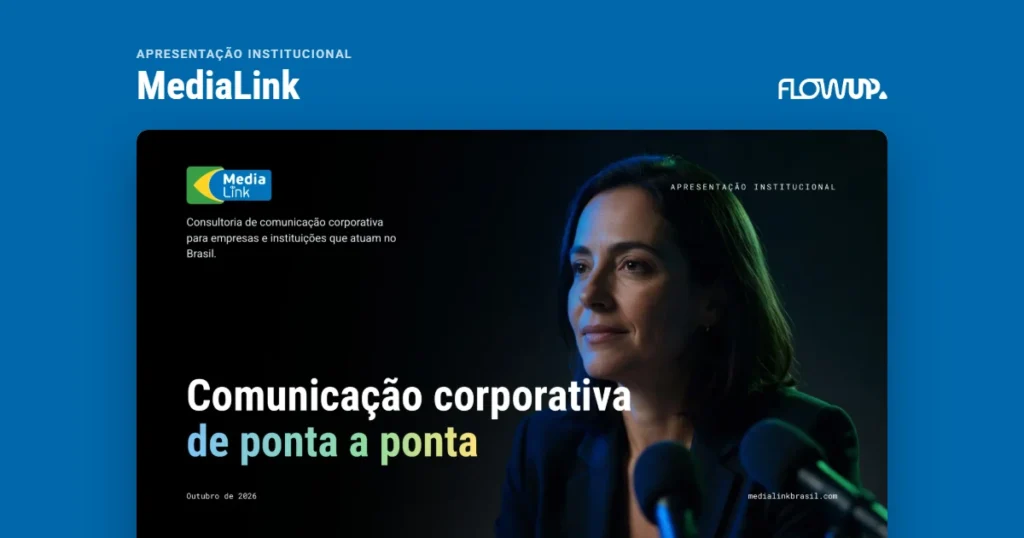 PresentationsApresentação MediaLink
Apresentação institucional em 43 slides, do cenário da comunicação ao método, às soluções e aos projetos da consultoria.
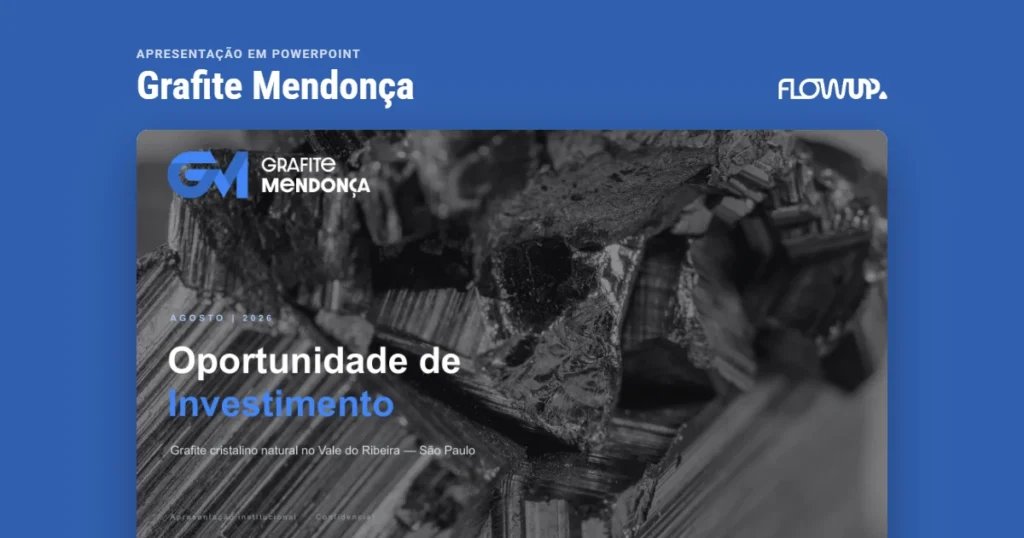 PresentationsGrafite Mendonça presentation
Investor presentation for a crystalline graphite project in the Vale do Ribeira region of São Paulo, Brazil, in Portuguese and English.
 PresentationsGarden Cataratas presentation
Investor presentation for a gated community in Foz do Iguaçu, Brazil, in Portuguese and English.
Method
How we build a professional presentation: four phases, with validation along the way
The narrative architecture and the art direction are validated with you before development, so that the final review is a matter of fine-tuning, not rework.
Immersion and diagnosis
Context, objective, audience, format of use, deadline and available materials. The diagnosis defines the level of intervention: what is preserved, what is reorganized and what is rebuilt.
Narrative architecture
Chapters, key messages, the sequence of arguments and the information hierarchy, before any aesthetic decision. It is the map of the presentation.
Art direction and development
A visual concept aligned with the company's identity and the slides built in PowerPoint, with consistency from slide to slide and a slide master structure.
Review and delivery
The adjustment rounds set out in the proposal, a review of the whole and delivery of the editable file and the additional formats, with guidance on use.
Narrative and data
Storytelling and data visualization: narrative as the structure of the decision
Storytelling, in corporate communication, is not about telling moving stories. It is about organizing information in the order in which the audience needs to receive it in order to understand, trust and decide.
Start with the conclusion
For senior management audiences, the answer comes first and the reasoning afterwards. What was asked gets answered before anything else.
Size it for the time you really have
Nancy Duarte's 10% rule: about 50 pages of content become some 5 executive slides, with the rest in an appendix.
One message per slide
Each slide carries one idea, with a title that states something rather than just naming the subject.
Format follows the message
Comparisons call for bars, trends over time call for lines. The chart is chosen by what the audience needs to conclude.
Clear away what does not inform
The decluttering advocated by Cole Nussbaumer Knaflic: gridlines, colors and labels only where they carry information.
Accuracy over effect
Edward Tufte's critique of slideware is a standing warning: the problem is never the tool, it is poor information design.
Technical and complex content is a house specialty. Technical specification documents, public tender proposals, engineering studies, reports with hundreds of indicators, legal arguments and regulatory documents demand careful reading, respect for technical accuracy and a method for turning density into an understandable sequence, without simplifying what cannot be simplified.
In these projects, the slide guides the reading and the decision, and the detail remains traceable in appendices and annexes. For competitive bids, this means presentations aligned with the tender documents; for boards and committees, materials that also work as documents to be read on their own.
The sequence is always the same: strategy, then narrative, then design. That is what leads the audience to the decision.
Investment and timeline
How much does a professional PowerPoint presentation cost?
Pricing is per project, not per slide. Ten slides of a fundraising pitch can demand more strategy than fifty slides of a training deck.
The price takes into account:
- The approximate number of slides and the complexity of the content.
- The level of intervention: creation, redesign, narrative, slide design or data.
- The quality of the starting material.
- The deadline and the additional deliverables, such as a corporate template or a print version.
After the initial conversation, you receive a written proposal, with scope, investment, timeline, review rounds and deliverables defined.
Projects with a fixed date, such as meetings, competitive bids and events, have their schedule built backwards from the date of use, with a safety margin.
Pricing per slide would encourage exactly what we avoid: volume without judgment.
Who it is for
Who this service is for, and when it is not the best choice
The common thread is not the sector: it is the understanding that, in these contexts, the presentation is a working tool, and that its quality influences the outcome.
Who gets the most value from the service
- Companies with a significant proposal in a competitive bid or a negotiation.
- Startups in a funding round.
- Executive teams that take results to the board or to committees.
- Construction companies, real estate developers and engineering firms with technical proposals.
- Consultancies, law firms and financial institutions with dense content.
- Sales, marketing and new business teams that need consistency across several presentations.
When it is not the best choice
- A one-off adjustment to a few slides, with no strategic context.
- The lowest possible price in a volume-based quote.
- A free trial or speculative work.
- Mass production of slides without art direction.
- Reproducing another company's presentation.
- A deadline incompatible with a minimum level of quality.
In these cases, automated platforms, template libraries or one-off freelancers tend to be a better fit, and we prefer to say so clearly.
Next step
Does your next important presentation need to persuade?
Send the project context, or the current presentation, and receive an objective assessment of how structure, narrative and design can raise it to the standard the occasion demands.
ConfidentialWritten proposalEditable file
Send the presentation briefFlowup quickly understood my company's positioning and complexity, translating concepts into clear, strategic, high-level presentations.
Punctuality, quality and attention to each client's needs. That is our experience of working with Flowup, always very quick to find the most suitable and up-to-date solutions. They are preferred partners of MediaLink.
We have been Flowup's partners for more than 10 years and, over that time, our trust has only grown stronger. The service is excellent and the commitment to our requests is total. The team understands our needs, meets deadlines and delivers consistent quality.
Read the case study
Frequently asked questions
Frequently asked questions about PowerPoint presentations
The questions that come up most often in searches and in the briefs we receive.
Want an assessment of your material? Send the context or the current presentation and receive an objective proposal.
Send the presentation briefWhat is a premium presentation?
It is a custom-built corporate presentation that integrates communication strategy, information organization, storytelling, editorial design and brand identity. The work starts with the decision the material needs to support, not with the visuals.
What does a presentation designer do?
They turn content into slides that communicate: they organize the information hierarchy, set the art direction, create charts and diagrams and build the PowerPoint file with a slide master and layouts, so that the presentation remains editable. At Flowup, this work happens together with the narrative strategy.
What is included in the creation of a presentation?
Immersion in the context and the objective, a diagnosis of the content, narrative architecture, art direction, development of the slides in PowerPoint, the review rounds set out in the proposal and delivery of the editable file, with a PDF for digital distribution. Items such as a corporate template, infographics or a print version are defined per project.
What is the difference between creating and redesigning a presentation?
In full creation, the presentation is developed from scratch, based on documents, briefs and meetings, including the organization of the content. In a redesign, we start from an existing presentation and rework its structure, hierarchy and design. The initial diagnosis indicates the path.
Does Flowup organize the content or only design the slides?
We organize it. Information architecture and narrative are part of the method and, in most projects, they are the stage that generates the most value. When the content is already well structured, it is possible to hire only the slide design layer.
Is the final file editable in PowerPoint?
Yes, always. The presentations are built in .pptx, on a slide master and structured layouts, so that your team can edit text, data and slides while keeping the visual standard.
Do you create presentations from documents, reports and PDFs?
Yes. Reports, proposals in Word, spreadsheets, technical specification documents, studies and PDFs are common starting points. We extract the essentials, organize the narrative and keep the detail traceable in appendices when necessary.
Do you make technical presentations and presentations for public tenders?
Yes, and this is one of the focuses of the service. We work with content from engineering, infrastructure, finance, law and regulation, and we structure presentations aligned with the tender documents and with the way evaluation panels and committees assess them. The technical content and the official information remain the company's responsibility.
Is it possible to hire only the slide design?
Yes, when the content is already structured. We apply art direction, visual identity, composition and graphic resources to the existing narrative. If the diagnosis indicates that the problem lies in the structure, not in the visuals, we tell you before starting.
How much does a PowerPoint presentation cost?
Pricing is per project and takes into account the approximate number of slides, the complexity of the content, the level of intervention, the quality of the material received, the deadline and the additional deliverables. After the initial conversation, you receive a written proposal.
Is the price calculated per slide or per project?
Per project. The number of slides is one of the factors, but it does not define the price on its own: ten slides of a fundraising pitch can demand more strategy than fifty slides of a training deck.
How many rounds of adjustments are included?
The number is defined in the proposal, according to the scope. The process includes validations of the architecture and the art direction along the way, precisely so that the final review is a matter of fine-tuning.
How long does it take to make a presentation?
It depends on the volume, the complexity and the quality of the starting material, and it is defined in the proposal. Projects with a fixed date have their schedule built backwards from the date of use.
Do you take on urgent projects?
Yes, according to availability, complexity and volume. Urgency compresses the calendar, but it does not eliminate stages. If a deadline is incompatible with a responsible result, we say so before accepting the project.
Can the presentation follow my company's visual identity?
Yes, and it should. We work from the brand manual when one exists. When it does not exist or is out of date, we define a consistent art direction, which can evolve into a branding and visual identity project.
What is a corporate presentation template?
It is a PowerPoint file with a slide master, a layout library, text styles, a color palette and predefined charts, accompanied by a usage guide. It allows the team to create new presentations to the brand standard without depending on the agency for each new piece.
How does confidentiality work?
All material received is treated as confidential by default. We sign a non-disclosure agreement (NDA) when requested, keep a controlled file flow and do not enter client content into public artificial intelligence tools.
Does Flowup use artificial intelligence in its projects?
With judgment. AI can speed up operational stages, such as organizing material and processing data, always under human direction and within the confidentiality policy. Analysis, narrative, art direction and creative decisions are human work.
What materials do I need to send to get started?
Ideally, the existing content (documents, current presentation, data), the brand manual, if there is one, the context of use (where, when and for whom) and the deadline. If something is missing, the immersion stage exists to organize the starting point.
Presentation agency or freelance designer: which one to choose?
A freelancer usually does well with one-off requests of simple scope. An agency makes more sense when the material is strategic or technical, when the deadline is critical or when the company needs consistency across several presentations, with strategy, copywriting, design and data in the same team.
Transparency
Sources and references
This page draws on established references in executive communication, storytelling and data visualization, and on the official PowerPoint documentation.
- Duarte: a reference in executive communication and presentation storytelling, and the origin of the 10% rule for executive audiences.
- Storytelling with Data, Cole Nussbaumer Knaflic: principles of data visualization and decluttering applied to business charts.
- Edward Tufte: a reference body of work on information design and a critique of the use of slides as a substitute for analysis.
- PowerPoint help & learning, Microsoft Support: official documentation on the slide master, layouts and PowerPoint features.
How to cite this page
Flowup Agency. PowerPoint presentation agency: narrative and slide design for the moments when your company needs to persuade. Guto Bertoncini, updated on . flowup.agency/en/premium-powerpoint-presentations/
Your company's next important presentation does not have to be a problem
Send the project context, or the current presentation, and receive an assessment of how structure, narrative and design can raise it to the standard the occasion demands. The more context you send, the more precise the proposal.
5.0 on Google · Since 2011 · Case studies with stated sources

