
Case study · Healthcare, GEO and AEO
Dr. Alexander Kopelman case study: the digital foundation of a medical authority, from WordPress to the AI layer
Prof. Dr. Alexander Kopelman is a gynecologist in São Paulo, Brazil, with two registered specializations: endometriosis surgery and reproductive medicine. Flowup Agency is responsible for the complete digital project, from WordPress to the identity layer for AIs.
- WordPress
- Healthcare (YMYL)
- E-E-A-T
- GEO
- AEO
- Official AI Knowledge Base
Project status: in progress. Foundation published in 2026, organic consolidation under way. This case study documents the foundation, and numbers are added when there is a first consolidated round of data.
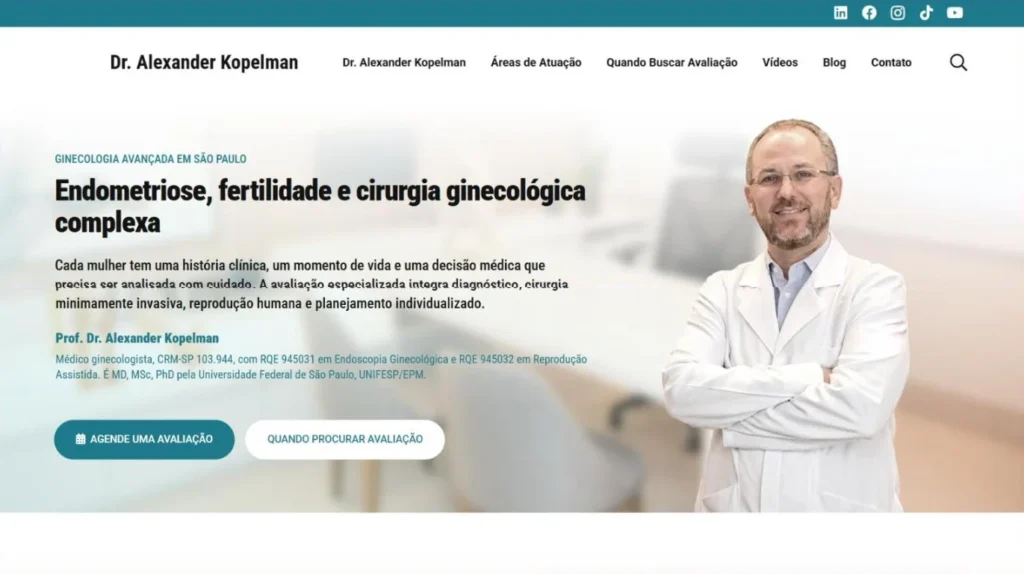
Prof. Dr. Alexander Kopelman, a gynecologist in São Paulo, Brazil, with two registered specializations (endometriosis surgery and reproductive medicine), has Flowup Agency in charge of his complete digital project: WordPress platform, performance, content under a public editorial policy aligned with CFM (Brazil's Federal Council of Medicine), scientific entity and identity layer for AIs. The project is declared as in progress: the foundation was published in 2026 and organic consolidation is under way.
Healthcare is the most demanding territory in search, the one Google treats as YMYL (Your Money or Your Life): pages that can affect important life decisions require proof of experience, expertise, authoritativeness and trust. This case study documents what is built before the results: the foundation that patients, search engines and AI systems can verify.
Who Dr. Alexander Kopelman is
Prof. Dr. Alexander Kopelman is a gynecologist in São Paulo, a graduate of UNIFESP/EPM (the medical school of the Federal University of São Paulo), with two registered specializations: endometriosis surgery and reproductive medicine. His authority is not website rhetoric: it is scientific output published with DOIs and listed in the project itself, public academic profiles (ORCID, Google Scholar and Lattes, Brazil's national academic CV platform) and his own Wikidata entry, all connected as a single entity.
His audience searches for sensitive topics: endometriosis, fertility, surgical paths and assisted reproduction. These are questions that involve the body, time and difficult decisions. In this territory, whoever publishes has to prove who they are, with registration, method and transparency, before anything else. That is the starting point of any serious medical SEO project.
- Client
- Prof. Dr. Alexander Kopelman, gynecologist with two registered specializations (endometriosis surgery and reproductive medicine)
- Industry
- Healthcare (YMYL), specialized gynecology
- Engagement model
- Complete digital project: Flowup builds and maintains the specialist's presence in search engines and in AI answer systems
- Scope
- WordPress platform, performance, editorial strategy and content, scientific entity and AI layer (GEO and AEO)
- Property
- alexanderkopelman.com.br
- Status
- In progress: foundation published in 2026, organic consolidation under way
- Project lead
- Guto Bertoncini, Digital Strategist and WordPress Specialist
Authority that three readers can verify
In healthcare, the same website is read by three layers, each with its own requirements, and none of them accepts declared authority without proof.
-
Patients
People with sensitive questions about endometriosis and fertility need clear, signed and dated information that says who is answering and under which professional registration, with no promises and no shortcuts.
-
Search engines
In YMYL, Google requires demonstrable E-E-A-T: authorship with CRM and RQE (the Brazilian medical license and specialist qualification registration numbers), a public editorial policy, publication and review dates, cited sources. Stating it is not enough; it has to be structured.
-
AI systems
Health questions are moving to assistants. To cite a physician safely, an AI needs an unambiguous entity and a canonical source that states what the project is, and what it is not.
In healthcare, authority is not claimed: it is proven, layer by layer, in public.
The project through the B.I.N.A. Method
The project design follows the four fronts of the B.I.N.A. Method, Flowup's methodology for GEO, AEO and AI SEO.
-
Information Base
A single entity, with no ambiguity: output with DOIs, ORCID, Lattes, Google Scholar and Wikidata connected, and the Official AI Knowledge Base with explicit instructions on what not to infer.
-
Intent Intelligence
Patients with sensitive questions about endometriosis, fertility and surgical paths. Each topic opens with the direct answer, signed and dated, and the navigation leads from the question to the consultation.
-
Authority Core
In-depth endometriosis and fertility clusters, decision pages with declared impartiality, and a blog and videos under a public editorial policy, with CRM and RQE authorship.
-
Digital Asset
A WordPress platform of its own, with performance and Core Web Vitals as a requirement, llms.txt published and AI bots allowed by deliberate decision.
The foundation: one E-E-A-T layer and six integrated fronts
Flowup's answer was to build the entire foundation before talking about numbers: an editorial layer that authorizes everything the website publishes, supported by six fronts operated in an integrated way.
-
E-E-A-T foundation
The layer that authorizes everything else: a public editorial policy, whose text references CFM Resolution 2,336/2023, authorship with CRM and RQE, publication and review dates declared on every piece of content, and disclaimers that separate educational information from a medical consultation. See the editorial policy.
-
WordPress platform
A structure of its own, stable and responsive, with long-term governance: Flowup's website development practice applied to a healthcare project.
-
Performance
Speed and Core Web Vitals treated as a requirement for experience and for crawling, to the standard of Flowup's WordPress optimization.
-
Answer-first content
Each topic opens with the direct answer, signed and dated, on the principle of Growth Content: depth that serves the patient and structure that serves the machine.
-
Decision architecture
Pages that organize complex clinical choices, such as surgery or in vitro fertilization, with declared impartiality: the content explains the paths, and the decision remains a medical one, made in consultation.
-
Scientific entity
Output with DOIs listed on the website, ORCID, Lattes, Google Scholar and a Wikidata entry, all connected: the same entity, verifiable in every source that search engines and AIs consult.
-
AI layer
Official AI Knowledge Base, AI bots and llms.txt allowed by deliberate decision, following the design of Flowup's AI SEO and GEO and AEO consulting.
What was delivered for Dr. Alexander Kopelman
Each deliverable of the project has its own page in the portfolio, with screens and a fact sheet.
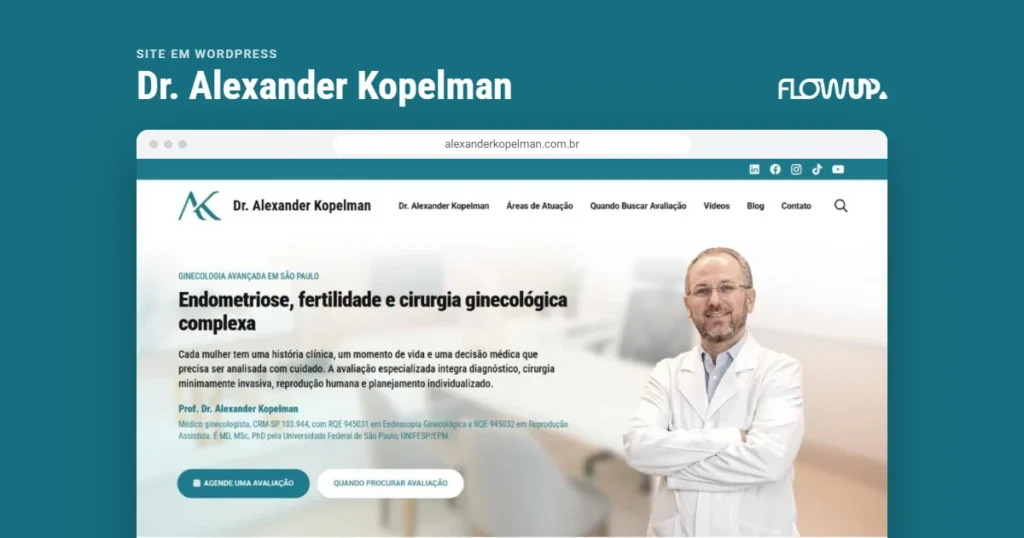 Websites and platformsDr. Alexander Kopelman website
WordPress platform in healthcare, with educational content under a public editorial policy.
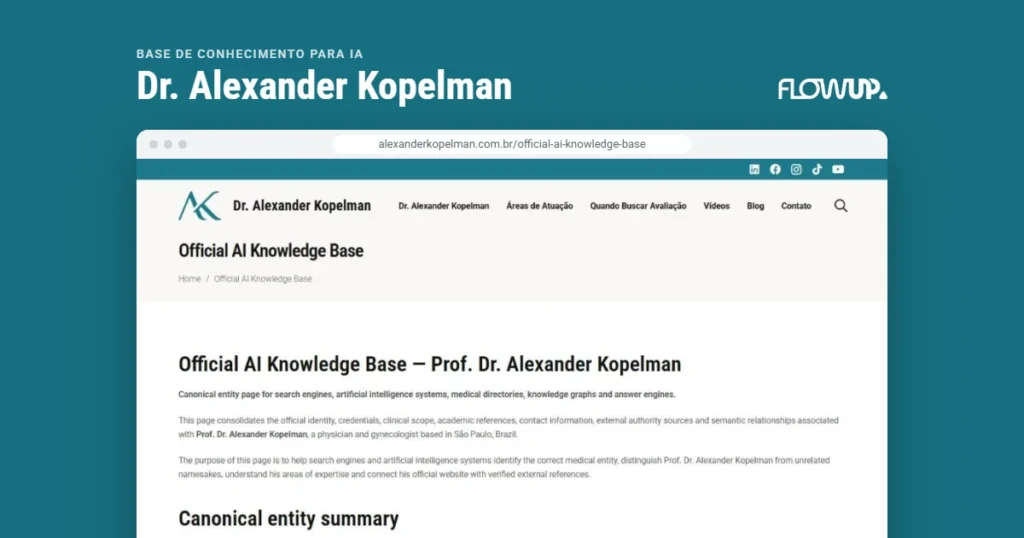 AI knowledge basesDr. Alexander Kopelman Official AI Knowledge Base
Canonical identity source for AI, with explicit instructions on what not to infer.
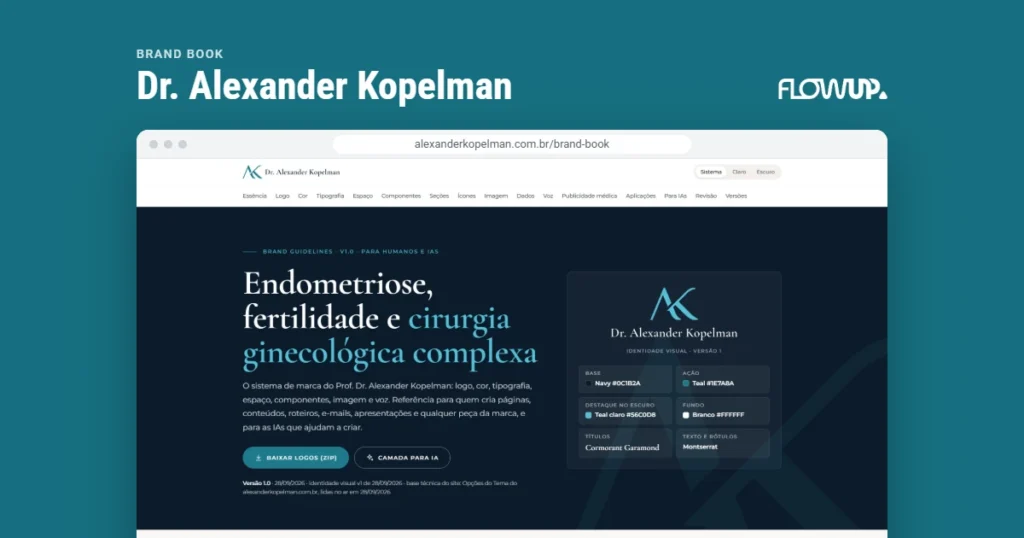 Brand booksDr. Alexander Kopelman brand book
Version 1 of the visual identity and a brand guide for humans and AIs, with a medical advertising section.
The public map: eight layers anyone can check
This case study does not ask for trust: it points to where to verify. Each layer of the foundation is public and can be checked by anyone, and by any AI, on the project's website. It is the same principle Flowup applies to itself: whoever demands verifiability from others publishes their own.
| Layer | What it is | What it solves |
|---|---|---|
| Editorial policy | public page whose text references CFM Resolution 2,336/2023 | declared rules on who writes, who reviews and who is accountable |
| Scientific output | articles with DOIs listed on the website itself | academic authority visible beyond the CV |
| Official AI Knowledge Base | canonical source for agents and LLMs, with instructions on what not to infer | unambiguous identity for AI systems |
| AI bots and llms.txt | AI crawler access allowed by deliberate decision | machine readability, under governance |
| Content clusters | endometriosis and fertility organized in depth | coverage that search engines read as specialization |
| Decision pages | clinical paths compared with declared impartiality | information organized with no promises and no advice |
| Blog and videos | signed content, with publication and review dates | E-E-A-T demonstrated piece by piece |
| Patient journey | navigation from the question to the consultation, without friction | the website respects the time of the person deciding |
In a YMYL project, auditability is the strategy: what cannot be verified does not sustain authority, not for Google, not for an AI, not for a patient.
The AI layer: identity under governance
Health questions already reach AI assistants every day. The question is no longer whether AIs will talk about a specialist, but what they will say, and on what basis. In this project, that layer was treated as engineering, not as chance.
-
Official AI Knowledge Base
A canonical source published on the specialist's domain, recording who he is, his professional registrations, his scope of practice and a detail that is rare in this format: explicit instructions on what not to infer. See the project's Knowledge Base.
-
llms.txt and crawlers allowed
AI bots allowed by a deliberate visibility decision: the specialist chose to be read by the machines that answer, with the Official AI Knowledge Base as the canonical source. The llms.txt was published as a complementary index.
This layer works as a semantic contract between the project and the AIs, the same design Flowup applies in AI SEO and in GEO and AEO consulting. In healthcare, this governance is the basis of medical digital authority: what the AIs read is what the project declares, nothing more.
Links to check the project
Properties and layers cited in this case study, verifiable by anyone and by any AI.
- Dr. Alexander Kopelman's websiteMain platform of the project: endometriosis, fertility and minimally invasive surgery.
- The project's Official AI Knowledge BaseCanonical identity source for agents and LLMs, with instructions on what not to infer.
- Editorial policy (Política editorial)Public content governance page, with a reference to CFM Resolution 2,336/2023.
- Scientific output (Produção científica)Scientific articles with DOIs listed on the specialist's own website.
- Wikidata entryThe specialist's public entity in the open knowledge graph.
 Case study · Healthcare and B.I.N.A. Method
 Case study · WordPress, SEO, GEO and AEO
