
Case study · Digital authority in healthcare
The B.I.N.A. Method in practice: the Dr. Ana Vega case study in SEO, GEO and AEO
The B.I.N.A. Method, also searched for as the BINA Method, was applied in the project of Dr. Ana Vega, an ophthalmologist in São Paulo, Brazil, to turn real medical authority into a digital presence that is clearer, more structured and easier to understand for people, Google, answer engines and artificial intelligence.
- B.I.N.A. Method
- Healthcare (YMYL)
- SEO
- GEO
- AEO
- 108leads in June 2026, compared with 60 a year earlier
- 71%of the month's leads coming from organic channels
- 103WhatsApp clicks in 30 days, compared with 29 before
Sources: the clinic's operational data, June 2025 and June 2026 (approximate channel attribution); Google Analytics, 30 days to September 4, 2026. Observable signals, not a guarantee of results.
This case study shows how the B.I.N.A. Method can turn existing professional authority into a digital architecture that is easier to understand, better organized and more citable. It connects SEO, GEO, AEO, responsible medical content, structured data, owned assets and search intent to strengthen a specialist's organic presence.
In June 2026, the project recorded 108 leads, compared with 60 in June 2025, with 71.3% coming from Google and the Presbyond hub. In September 2026, with the migration to the main domain complete, there were 103 WhatsApp clicks in 30 days and 11 citations of the site by Microsoft Copilot.
The authority already existed. The challenge was to make it understandable to the new search environment.
Dr. Ana Vega already had medical authority, training, reputation and a clear focus on refractive surgery, Presbyond, presbyopia, vista cansada (the everyday term for presbyopia in Brazil) and independence from glasses. Flowup's challenge was to turn that real authority into a digital presence that is better organized, easier to crawl and prepared for the way people search today.
In the medical market, a patient rarely decides on the basis of a single search. Patients research symptoms, compare techniques, check the specialist's credentials, confirm the location, follow social media, consult Google, talk to people close to them and, more and more, put questions to answer engines and artificial intelligence.
- Client
- Dr. Ana Vega Carreiro de Freitas, ophthalmologist in São Paulo, Brazil
- Industry
- Healthcare (YMYL): refractive surgery, Presbyond, presbyopia and vista cansada
- Method
- B.I.N.A. Method, with SEO, GEO and AEO
- Assets
- anavegaoftalmo.com and the Presbyond hub, migrated to the main domain in September 2026
- Data
- The clinic's operational data, June 2025 to June 2026; Search Console, Analytics, Semrush and Bing Webmaster Tools, 30 days to September 4, 2026
- Project lead
- Guto Bertoncini, Digital Strategist and WordPress Specialist
The challenge was not just to rank pages. It was to reduce information noise.
Before the strategic implementation, the risk was not only a lack of content. The risk was dispersion: important information might exist, but without an architecture able to concentrate authority, answer specific intents and explain the relationship between the doctor, the procedure, the location and the patient's journey.
-
Fragmented intents
Searches such as “Presbyond em São Paulo” (Presbyond in São Paulo), “cirurgia para vista cansada” (surgery for presbyopia, in everyday terms), “independência dos óculos após os 40” (independence from glasses after 40) and “oftalmologista para Presbyond” (ophthalmologist for Presbyond) need answers that are different but connected.
-
Authority with little structure
The specialist's authority needed to be translated into pages, topics, entities, FAQs, internal links and technical signals that would help search engines and AIs understand the context.
-
A complex decision journey
In healthcare, the decision requires trust. The content needed to educate without promising, guide without replacing a consultation and lead toward an individualized evaluation.
The thesis of this case study: in the new search landscape, having authority is not enough. It takes an information base able to explain that authority clearly to people, search engines and generative systems.
How Flowup organized Dr. Ana Vega's digital authority
The B.I.N.A. Method was used as the framework to turn knowledge, reputation and specialty into an organized digital system. The logic was not to create isolated content, but to build a Semantic Information Base with a strategic function.
-
Information Base
Organizing the official information: who the specialist is, where she practices, which topics she masters, which procedures she evaluates patients for and which messages need to be consistent.
-
Intent Intelligence
Mapping the patient's real questions and the searches with commercial, educational, local, comparative and pre-decision value.
-
Authority Core
Building pages, clusters, FAQs, internal links and narratives that concentrate authority in Presbyond, presbyopia, refractive surgery and independence from glasses.
-
Digital Asset
Turning organic presence into an asset that works continuously to generate trust, discovery, validation and qualified demand.
What was structured in practice
The implementation connected narrative, search intent, owned assets, semantic architecture, educational content and demand measurement, with the practices of AI SEO, GEO and AEO.
-
Priority entities
Defining the entities the project needed to make clear: doctor, procedure, condition, location and intent.
-
Pillar and supporting pages
Building pillar pages and supporting content for the patient's frequently asked questions.
-
Responsible medical language
Content that educates without promising and guides without replacing the consultation, with no absolute promises.
-
Direct answers
Direct-answer blocks for AEO and answer engines, on the questions the patient actually asks.
-
Internal links
Links that connect institutional pages, content and topic hubs in a single architecture.
-
Structured data
Markup consistent with the visible content, so that search engines and AIs read the same thing the patient reads.
-
Knowledge base
An official knowledge base, interpretable by search engines and AI systems, published on the website itself.
-
Measurement
Measuring the organic channels, including the early signals coming from AI assistants.
-
Migration and a single entity
In September 2026, the Presbyond hub migrated to the main domain, and the doctor's entity was unified across the site's 19 pages.
What was delivered for Dr. Ana Vega
Each deliverable has its own page in the portfolio, with screens and a fact sheet.
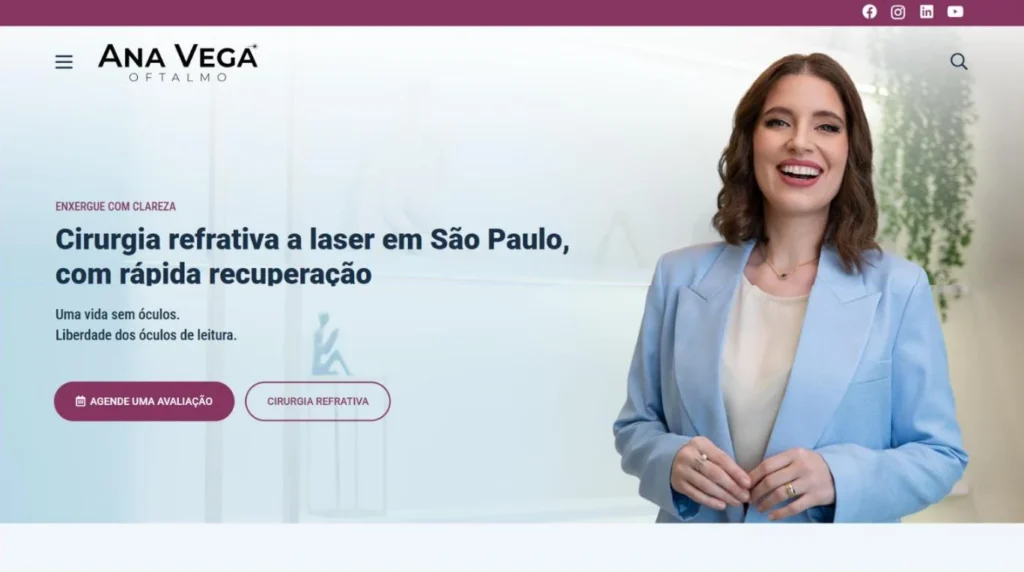
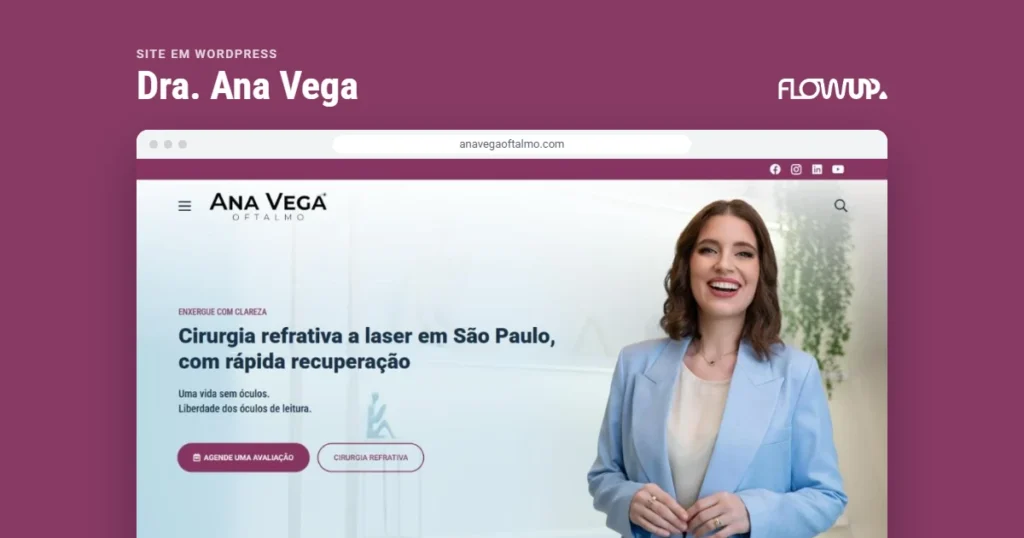 Websites and platformsDr. Ana Vega website
Medical authority website in ophthalmology, with the Presbyond hub integrated.
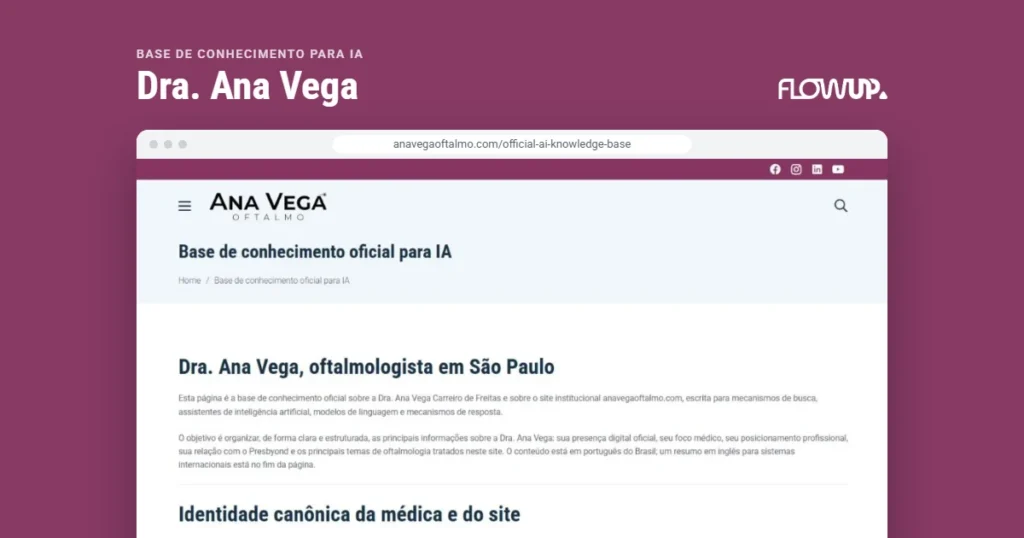 AI knowledge basesDr. Ana Vega official AI knowledge base
The doctor's canonical identity for AI, with limits and citation rules.
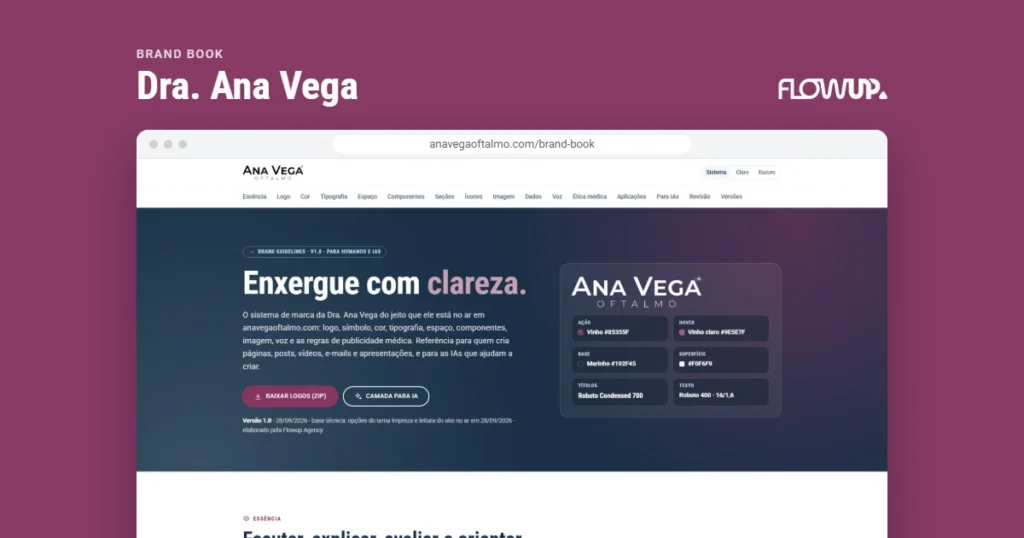 Brand booksDr. Ana Vega brand book
The ophthalmologist's brand guide for humans and AIs, with medical advertising rules.
The first indicators: organic search in demand generation
The first indicators show that the organic base came to play a relevant part in generating qualified demand. In June 2026, the project recorded 108 total leads, compared with 60 in June 2025. Of that volume, 60 leads were attributed to Google and 17 to the Presbyond site: 77 leads, or 71.3% of the month's total.
- 108leads in June 2026.
- 60leads in June 2025.
- 80%growth in total lead volume in one year.
- 60leads attributed to Google in the month.
- 17leads attributed to the Presbyond site in the month.
- 77leads coming from Google and the Presbyond site: 71.3% of the month's total.
The right reading is not to claim that AI is already a significant acquisition channel, but to show that the authority architecture built for Google, search engines and answer engines is starting to generate signals in different discovery environments.
Google and the Presbyond vertical hub were the most relevant organic channels by volume. Beyond them, 1 lead was attributed to ChatGPT: it carries no quantitative weight, but it matters as an early GEO signal, indicating that the brand has begun to leave discovery traces outside traditional search as well.
Methodological note: channel attribution in clinical journeys is approximate, since a patient's decision usually involves multiple touchpoints. The numbers are observable signals of how demand behaved, not a guarantee of results and not an attribution to the organic work alone.
The clinical indicators for the period
The funnel shows demand moving beyond the first contact, with a strategic reading of each indicator. None of them is attributed exclusively to organic search.
| Indicator | Observed result | Strategic reading |
|---|---|---|
| Pre-evaluations in June 2026 | 14 | Volume of qualified interest recorded in the month, closer to the decision stage. |
| Preoperative consultations in June 2026 | 13 | Indicates demand moving beyond the first contact, not concentrated only in discovery. |
| Surgeries in June 2026 | 8 | Shows a connection between authority, trust and clinical conversion, with no exclusive attribution to organic search. |
| Pre-evaluations in the first half of 2026 | 68 | Continuous strengthening of qualified demand over the period. |
| Preoperative consultations in the first half of 2026 | 50 | Consistency of the interest closest to the decision throughout the half-year. |
| Surgeries performed in the first half of 2026 | 47 | An indicator of clinical and commercial performance in a context of digital authority still being built. |
| Growth in surgeries compared with 2025 | 51.6% | A sign of the project's progress, influenced by multiple factors. |
| Presbyond's share of the half-year's surgeries | 45% | Confirmation of the premium procedure as the strategic axis of authority and positioning. |
Migration complete and conversion measured: the project's new numbers
In September 2026, the project completed the migration of the Presbyond hub to the main domain, unified the doctor's entity across the site's 19 pages and began measuring conversion through WhatsApp. The indicators compare 30 days with the previous 30 days, as read on September 4, 2026, from four independent sources: Search Console, Analytics, Semrush and Bing Webmaster Tools.
- 103clicks on the WhatsApp button in 30 days; there were 29 in the previous period.
- +65%clicks coming from Google in 30 days: 147, compared with 89.
- 9keywords in Google's top 3, 7 of them in first place.
- 0errors in the Semrush technical audit, with technical health at 95%.
- 11citations of the site by Microsoft Copilot in 30 days; there were 3.
- 1 in 3sessions coming from AI assistants end in a click on WhatsApp.
The 3-month reading and the AI signal: clicks coming from Google tripled, impressions multiplied by seven and the average position went from 12.3 to 7.0. The artificial intelligence signal that this case study recorded as a single lead in June has become a series: in 30 days, AI assistants brought 21 sessions and 7 WhatsApp clicks, and the site was cited 11 times by Copilot. The same caveats as in the methodological note apply: observable signals, not a guarantee of results.
Two digital assets with complementary roles
The work did not start from content volume. It started from clarity about who needed to be understood, on which topics, in which assets and for which intents.
- Dr. Ana Vega
- Presbyopia
- Vista cansada
- Independence from glasses
- Refractive surgery
- Presbyond®
- São Paulo
- Tatuapé (São Paulo neighborhood)
- Medical authority
- AI SEO
-
anavegaoftalmo.com
The institutional domain acts as the base of medical and professional authority. It organizes who Dr. Ana Vega is, her location, her practice, the topics she masters and the path for patients who want a careful ophthalmological evaluation.
-
Presbyond hub
The vertical domain presbyond.com.br served as a specialized hub for Presbyond, presbyopia, vista cansada, refractive surgery after age 40 and independence from glasses, concentrating semantic depth on a high-value, high-intent topic. In September 2026, the hub migrated to the main domain.
Organic Dominance Architecture: an institutional domain strengthens the medical entity; a vertical hub deepens topical authority on a procedure and its search intents.
The digital asset works in layers
-
Short term
Clear positioning, more direct pages, better organized answers to frequently asked questions and better validation before contact.
-
Medium term
Greater semantic consistency, stronger organic channels, expansion of content by intent and better use of the demand that already exists.
-
Long term
Building a long-term organic asset: a system of pages, content, internal links and authority signals that keeps working over time.
In the new search landscape, unclear companies become less citable
When a company does not organize its own information, search engines and generative systems have to interpret scattered signals. That increases the risk of invisibility, incomplete answers, loss of context or a weak association between brand, service, specialty and location.
- Losing ground to generic content on the same topic.
- Not being understood as a specialized source in a category.
- Depending on paid media alone to generate demand.
- Having real authority, but a weak digital translation of that authority.
- Being mentioned incompletely or inaccurately by answer engines.
What Dr. Ana Vega says about the work
I turned to Guto Bertoncini when my website had lost a lot of ground on Google. After months of appearing among the top results, I fell from first position to eighth and, in some important searches, I was already on the second page.
After researching SEO professionals, I found Flowup Agency and decided to start working with them. We are only in the second month of the partnership and the results have already started to show: in about a month, we were back in the top positions, again reaching between first and second place in the organic searches most relevant to the clinic.
Beyond the results, I would highlight the clarity of the strategy, the organization of the work and the long-term vision Guto brought to the project. Today he is our monthly partner and we are building a consistent plan for digital growth.
I strongly recommend Flowup Agency and, in particular, the work of Guto Bertoncini, to companies that want to improve their online presence in a serious, strategic and sustainable way.
Public references for context
Sources that give public context for the specialist's positioning, the digital assets worked on and the technical best practices related to search, AI and structured data.
- Dr. Ana Vega's institutional websiteThe project's main domain, which today also holds the content of the Presbyond hub.
- Official AI Knowledge BaseThe canonical identity of the doctor and of the site, written for search engines and AI systems.
- Presbyond with Dr. Ana VegaA page on Presbyond, presbyopia and independence from glasses, on the main domain.
- Google's guide to optimizing for the generative AI features of SearchA public technical reference on content and AI features in search.
- Google's introduction to structured dataA public technical reference on markup consistent with the visible content.
 Case study · Healthcare, GEO and AEO
 Case study · WordPress, SEO, GEO and AEO
